Written
in 1980, with the serious collector in mind, this book notes all the
species then known to have been collected within 50 kilometers of the Nation's
Capital. Focus is on localities. Emphasized are the most significant localities
that were accessible at the time of publication. Scores of additional
localities, a total of 191, are also mentioned, their locations numbered on two
of the maps.
Thursday, July 24, 2025
A LINK TO "MINERALS OF THE WASHINGTON, D.C. AREA IS AVAILABLE
Saturday, December 4, 2021
Stuart Herring: Maryland's Most Prolific Field Collector
In the image
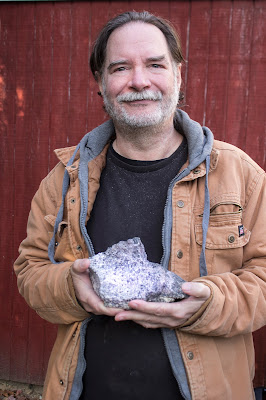
above, the specimen he holds is ore quality black chromite coated with violet colored chromian clinochlore (aka kammererite, rhodochrome, penninite) and white talc. He collected it at Bare Hills in Baltimore County. Until he uncovered this and other similar specimens, such material had not been collected in the area for nearly a century. The find is one of Maryland's most significant in the past 50 years.
Field collecting in Maryland has become immensely challenging. Localities that once yielded specimens have given way to sprawl. Strictly enforced laws prohibit collecting in state parks and national parks. Other sites are on private property that effectively forbid trespassing. Most of the few quarries that formerly allowed once a year visits from properly insured mineral societies now proclaim that liability issues prevent them from doing so.
How is it that Stuart is able to devote a major portion of his time to successfully collecting mineral specimens in and near his home state? He focuses much of his approach on rediscovering long forgotten localities, many of them no longer believed to exist.
Plenty has been published during the past two centuries regarding Maryland localities that at different periods were known to have yielded a variety of mineral species. Over time, most of these localities have been built over or otherwise become inaccessible or forgotten. Most of what was written about them appeared in a variety of publications that became obscure, some nearly impossible to obtain, until several years ago. Finally, the Internet came to the rescue.
Minerals of Maryland by Charles Ostrander and Walter Price was one such publication that in its day, many considered a "Bible" for such information. It named and briedly described by county most of Maryland's known localities and listed all the mineral species reported from each one. The Natural History Society of Maryland, which published it in 1940, made Minerals of Maryland available on line just three years ago.
Nearly as recently, Maryland Geological Survey similarly brought on line more extensive and specific information about the localities noted in Minerals of Maryland and added additional ones. Some of the varied publications provide maps that make finding these localities easier.
Lidar data in LAS files, especially when accessed with Arc Gis, has provided collectors with an additional tool for seeking out localities. The technology provides collectors with a description of the earth contours throughout the vicinities where the localities---if any traces of them still exist--- appear on the maps.
Such wonderful tools will only prove helpful to collectors with the knowledge to identify specific species as well as how to search for any that remain. Such knowledge combined with Stuart's extensive collecting experience and the time he has available to collect give him his edge. It helps that he earns a substantial portion of his livelihood as a mineral dealer.
In past posts, Mineral Bliss has feautred several finds Stuart has brought to light. They are as follows:
The Carroll Mine in Carroll County, Maryland
New Finds: Falls Road Corridor Near Baltimore City Line
The Garnets of Stony Run in Baltimore City
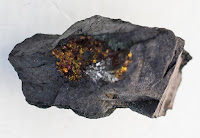
Stuart very likely has had more experience collecting at the Mineral Hill Mine in Carroll County than anyone else alive today. One of his proudest finds from the immediate vicinity of this iron and later copper mining operation dating from the 17th Century is pictured at left. The specimen bears silvery carrollite-siegenite with golden chalcopyrite in magnetite. The carrollite-siegenite portion measures to nearly an inch, which is considerably larger than the vast majority of the eponymous Carroll County carrollite examples curently known to exist. Stuart's most spectacular find in our opinion was the deposit of ore quality chromite with chromian clinochlore from Bare Hills in Baltimore County that he holds in our title picture.
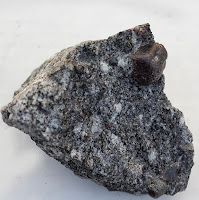
A more recent find is the almandine garnet specimen at right. Stuart collected in the Sparks-Glencoe area of Baltimore County along a stream where blasting had recently taken place. The spot was adjacent to a locality that an old Maryland Geological Survey publication had cited for kyanite. Needless to say, areas where blasting or construction has recently occurred are prime sources for potential mineral finds.
Wednesday, November 3, 2021
Peter Via Collection for Grand Reopening of JMU Mineral Museum
It is a
special event when a sizable group of mineral collectors gathers to be the
first to view a large selection of world class minerals. Recently attracting such a crowd was the former
Peter Via collection, which had recently been appraised $16,800,000. Upon his
death, he had bequeathed it to the James Madison University Mineral Museum in
Harrisonburg, Virginia,.
The
collection had never left Mr. Via's private home in Roanoke until he died in
2018. It was the largest gift the University ever received. Because of Covid, a
grand reopening event by invitation only at the museum’s new home had to be
rescheduled from April, 2020 to October 29, 2021.
The crowd
poured in to the Lower Drum of JMU's modern Festival Conference and Student
Center on its East Campus. With leaves approaching peak color, it was a prime time
of year to be in the area. Torrential rain and westbound traffic backed up for
numerous miles on I-81 West were less cooperative.
Notwithstanding,
the number of mineral aficionados that managed to attend the event was
substantial. After a short walk from easy parking, guests wound their way
downstairs to a large visitor-filled room where volunteers at a check- in table
handed out pre-printed tags. Penned onto each was a number referring to the
group with which the holder could enter the museum. Wine and a few snacks were
available to everyone. Down a short hallway, a designated group stood waiting
to enter the exhibit room entrance after a previous group had exited.
Unlike
others who were present, this writer had by special arrangement been able to
visit Mr. Via at his home in Roanoke
years before to see this amazing collection. I had photographed as many
specimens as time allowed and also enjoyed an opportunity to chat with Mr. Via in his den about his mineral collecting
philosophy.
Mineral Bliss's October 27, 2014 post, “Unbelievable but True
The World Class Personal Collection of Peter Via" resulted from that visit.
Subsequently, Dr. Lance Kearns, JMU's Emeritus Professor of Geology and Curator
of the Museum, with his wife Cindy, a current geology professor at JMU, spent time
with Mr. Via during the period when he decided to bequeath his collection to the
university.
When it
arrived, the world famous mineral photographer Jeff Scovil went to work with his camera. Also involved
was Wendell Wilson, the Publisher and Editor in Chief of MIneralogical Record. He personally
authored a 23 page article about the collection that appeared in that
publication’s September-October 2020 edition. At present, numerous images of the
specimens are available on line in association with a brief video narrated by
Dr. Kearns.
Lance and
Cindy Kearns were immediately inside the museum door as guests entered. When I
greeted Lance, he mentioned that Mineral
Bliss’s 2014 post had prompted the discussions leading to the bequest of
this amazing collection to James Madison University.
The
specimens intermingle with the larger collection that Dr.. Kearns describes as
"a composite of five collections." Prior to owning the Via specimens,
JMU had always displayed specimens in systematic suites based on chemical
composition and atomic structure. While the systematic arrangement remains
largely in place, many of the Via specimens are arranged in different kinds of
small groups, especially when based on visual qualities of a given species or
genre. In addition to specimens on display, JMU owns 1770 catalogued specimens
in storage. Some will undoubtedly be candidates for rotation into the display.
Thursday, October 22, 2020
A HIGHLY SUCCESSFUL VIRTUAL 2020 DESAUTELS MICROMOUNT SYMPOSIUM
Though assembled via Zoom because of Covid-19, the 64th annual Desautels International Micromount Symposium from Baltimore, Maryland, was a huge success. Chaired for the eighth time by Dr. Michael Seeds of Lancaster, Pennsylvania on behalf of the Baltimore Mineral Society, it happened October 10, 2020, at 1 PM Eastern Time.
Despite the absence of both dealers and live minerals, this
virtual Symposium drew a significantly larger crowd than live symposia of
recent years. Perhaps this could be
expected sans the time and expenses involved in travel to Baltimore from
destinations around the world. More significant was the glorious manner in
which the event executed its intended purposes
After Dr.
Seeds opened with a few pertinent introductions, he turned the proceedings over
to Col. Quintin Wight of Ottawa, Ontario, Canada, the symposium’s perennial
master of ceremonies and also the best known micromounter on the planet. The
most definitive part of each year’s Desautels Symposium relates to the
international Micromounters Hall of Fame. Quintin, of course, was one of the 40
per cent of living Hall of Fame members in attendance.
He noted the criteria for selection to the Micromounters Hall of Fame by emphasizing the pre-eminent qualification of being “loudest for longest” within the community of micromounters. Since so many micromounters appear to be quiet people, “loudest” in this context bespeaks volume of involvement in terms of contribution and service to the micromounting niche of the mineralogical community.
Nearly three hours had now passed. It was time for Al Pribula, President of the Baltimore Mineral Society to stage the Society’s annual voice auction. It hardly mattered that the offerings were so much fewer than if the event had been in person. The high level of enthusiasm that had been apparent at the outset had persisted and grown as if to a crescendo. Every minute had grasped the interest of those present, and it made the auction all the more fun.
Sunday, September 27, 2020
George Loud and His Mineral Collection
George houses his collection in an addition to his and Karen's home. It consists of three rooms devoted to mineralogy. One enters into what he refers to as his "man cave," where he is shown sitting with his yellow Labrador Molly. Micromounting materials are evident on many surfaces. The walls bear an assortment of personal as well as mining memorabilia.
The "man cave" leads into a hallway with a mineralogy and mining history library with bookshelves on both sides. They extend from floor to ceiling with a ladder system. Multiple shelves have so many books on Colorado minerals and mineral localities that protruding sheets of card stock divide them according to counties within Colorado.
Beyond the library is the collection room. What first meets the eye is a relatively small single cabinet with minerals from the famous but now off-limits Hunting Hill Quarry in Montgomery County, Maryland. Otherwise, the cabinets are much larger. Keith Williams, who constructed numerous mineral cabinets at the Smithsonian, built most of them.
Specimens displayed in a long row of cabinets lining the left wall begin with a suite from the locality that's closest to where George lived most of his life, the fabled Centreville Quarry in Fairfax County, Virginia. Our title picture shows a few of the specimens. As everyone thereabouts who is interested in minerals knows, this locality has yielded too many world class apophyllite and prehnite specimens for passing judgment as to the best ever. What George's suite accomplishes is to show just how perfect they can get.
Specimens from Amelia County, Virginia are plentiful in an adjacent cabinet. It would be reasonable to conclude that some of the specimens in the image at left could vie for best of species from their specific Amelia County localities. Prominently displayed nearby are several relatively huge specimens with varied matrixes featuring turquoise crystals from the Bishop Copper Prospect in Lynch Station, Campbell County, Virginia.
Provenance is paramount. His labels name as many previous owners as he can ascertain. The ultimate Phoenixville Lead Mining District anglesite specimen from the Wheatley Mine is a good example. Collected between 1855 and 1860, it had eight previous owners going all the way back to the famous mining magnate and mineralogist Charles Wheatley. George also records this same information and other pertinent data about every specimen on index cards accompanied by all previous labels.
The collection boasts many scores of suites and individual specimens beyon the very small fraction of them mentioned herein. Standing out is a sizeable suite of gemmy minerals from Maine, a superb suite from Bisbee, Arizona, and a suite from Franklin and Sterling Hill, New Jersey width a specimen that amazed me of native gold in willemite .
George made a point of showing me a witherite specimen from the Pigeon Roost Mine near Glenwood in Montgomery County, Arkansas It is pictured at left. Clearly one of his favorites, he believes it could be a contender for the best of the species known to exist.
Nearby, a suite from Magnet Cove Arkansas, a favorite collecting spot for George, bears special mention. It includes a crystal of andradite (var.) melanite, which George thinks could be the best of its genre ever collected there.
Another garnet that impressed me nearly as much was prismatic and from North Carolina's Spruce Pine Mining District. Among numerous North Carolina minerals, he also pointed out a crystal of anatase pseudomorph after titanite from Tuxedo Junction at Zirconia in North Carolina's Henderson County.
Sunday, August 16, 2020
PIEMONTITE NEAR CULP RIDGE PENNSYLVANIA AND NOW IN MARYLAND!
Three of us headed from Baltimore in search of piemontite on a hillside near Hamiltonban Township in the South Mountain area of Adams County, Pennsylvania. We parked along Mount Hope Road near Gum Springs Road. If we were going to find piemontite we knew it would occur in outcrops where reddish pink metarhyolite dominated. Soon we were following a trail along the base of the ridge.
Within a few minutes, we spotted some large boulders through the trees. Although no hint of a trail led to them, we bushwhacked about 20 yards uphill, found the reddish pink metarhyolite we were looking for and soon spotted some piemontite. It occurs mostly in adamantine radiated microscopic prisms exclusively at or near where quartz has intruded the metarhyolite. We believe we were in one of six known South Mountain area piemontite localities, at least four of which date from the 1890’s
We were also within about a quarter mile of seriously
overgrown dumps from copper prospects dating back yet further into the 19th
Century. This was one of about 20 known localities for native copper in
the South Mountain area. Always found in volcanic metabasalts, the copper
was from deposits that were much smaller than but otherwise closely resembled the enormous and lucrative
Keeweenaw deposit in upper Michigan. Although extensively prospected well into
the 20th Century, the copper never proved plentiful enough to be
viable.
The South Mountain area has long fascinated geologists. Their focus has always been less on the copper than the geologic history exposed by rocks over hundreds of millions of years
of erosion. Research regarding the piemontite occurrences, while thorough and specific, was limited to separate studies.
This region prominently straddles the Maryland line into
Frederick County, where the geology is similar. The Pennsylvania side calls it
South Mountain, Maryland calls it the Catoctins. Geologists have extensively
studied the rocks on the Maryland side as well. Nearly all the studies, however, have been specifically limited either to Pennsylvania or to
Maryland.
Some of the Pennsylvania studies at least acknowledged the presence of piemontite, even though sometimes referred to as “rusty epidote,” or "piedmontite." In one of a series of articles entitled Chronicles of Central Pennsylvania Mineralogy, the late Jay Lininger described the phenomenon: "Like the comedian Rodney Dangerfield who didn't get no respect." In Maryland, piemontite got less than no respect.It has received no mention.
Yet, piemontite has aesthetic qualities that make it a
highly appealing mineral species as a member of the epidote group, like zoisite
and allanite. John Sinkankas in Gemstones
of North America even listed “piemontite in rhyolite” as “semi-precious gem
cutting material.” Its presence shows less weathering and better luster within freshly broken rock. Though usually in radiating microscopic crystals as described, a few specimens that are less common bear larger crystals up to
about 15 mm. x 3 mm. Nearly all such
crystals have been fractured upon recovery. Seeing perfection is unrealistic. Piemontite is
neither common nor highly valued relative to many other species, but regard for it is rising. .
A few years ago, this writer was working a booth at a show
in the Towson, Maryland Armory. A man walked by with the most spectacular
South Mountain piemontite specimen I’ve ever seen. I’m sure he intended to sell
it, but he did not mention a price. After I complimented the specimen, he moved
on. Had this happened today, I would happily have emptied my wallet.
Nothing short of synchronicity could make sense of how this writer personally collected piemontite in Maryland’s Frederick County only three weeks before our recent collecting trip. I was clueless that piemontite was in a specimen picked up in a field less than a mile down a road leading west from the tiny hamlet of New London.
Three weeks later by sheer coincidence, a collector called
and asked me to join him to look for piemontite in Adams County and write a post
about it if we found any. We went, we
found piemontite, and it was obvious that the material in which we found it was
the same as the piece I’d collected near new London. Doing my research, I read something in the aforementioned article by Jay Lininger that aroused my curiosity. The article stated that that the renowned late
geologist Dr. Florence Bascom, in a her PhD thesis about piemontite, “proved that some of the pink colored rhyolites drew their color
from included piemontite.” I should mention that Dr. Bascom was the
first woman in the United States to earn a PhD in geology and later went on to establish
the Geology Department at Bryn Mawr University.
So I went out to the rock pile in the back yard and grabbed the metarhyolite I’d found near New London. A presence of piemontite was readily apparent. I did not report this as a new find for Maryland because it seemed quite obvious that the specimen was not indigenous to the field where I collected it.
However, metarhyolite has an established presence just
a few miles further west of New London in Maryland’s Catoctins. As long a some of it is the same color as the ubiquitous reddish metarhyolite on the Pennsylvania side of the state line, piemontite will very likely be present., Once uncovered and
verified, it could be a legitimate new find for Maryland.
Wednesday, May 6, 2020
Remnants of Maryland's Historic Patapsco Mine
A collector friend succeeded in locating what appeared to have once been a pit from one of the Patapsco Mines. On the ground nearby, we found lying on the ground several decent magnetite specimens with notable cleavage as well as rocks bearing significant malachite. Also present in a few rocks were very small amounts of epidote, pyrite, chalcopyrite, and bornite. We found no evidence of "carrollite."
After penetrating the surrounding dirt with a garden trowel, we found more that was too dirty to examine on site. The highlight of the day presented itself inside a rock that we broke open. Pictured at right, it appears to be chrysocolla, albeit of a deeper blue color than expected, some of which visually almost visually suggested azurite. The Natural History Society of Maryland's 1940 Minerals of Maryland publication by Ostrander and Price reported both species.Wednesday, August 21, 2019
Scoring East Coast Mineral Specimens at the East Coast Show
For serious aficionados in the eastern and northeastern United States, the annual East Coast Gem, Mineral, and Fossil show in West Springfield, Massachusetts, each year on the second weekend of August, is a summer highlight. It happens Friday through Sunday and fills the Better Living Center at West Springfield's Eastern States Exposition. The focus of this post limits itself to finding dealers at this show with significant quantities of East Coast-collected specimens available for purchase. These specimens, most collected in the northeastern United States, show up almost exclusively amongst the retail dealers in the Better Living Center as opposed to those in the adjacent building, where the merchandise is devoted to wholesale trade.
This largest gem, mineral, and fossil show to happen in the Eastern United States is much the same every year. A special and impressive mineral exhibit from a well-known collection always adorns an entrance area leading to the wider space where lines of merchandise fill a dozen aisles of tables and shelves manned by about 150 dealers. A few of these dealers sell significant quantities of East Coast-collected mineral specimens. In nearly all cases, the prices are fair, sometimes bargain level. With few exceptions, dealers return each year to the same spot they occupied the previous year. In that regard, this post could be helpful to collectors of East Coast minerals here in future years.

In 2019, however, some of the best East Coast bargains were offered by a first time vendor at an easy to miss table in the farthest corner from the show's entrance point. There, Bob Batic of Mountville, New Jersey traded as Bob's 2nd Act Collectibles. His personal collection was among those featured in the 2016 Mineralogical Record Supplement Mineral Collections in the American Northeast. For years, Bob's collection has evolved from worldwide with an East Coast emphasis to specializing in vintage East Coast specimens collected between 1875 and World War II. The transition produced plenty of notable specimens to sell, especially from older East Coast finds. Collectors found many of the prices to be irresistible.
Two rows past Mr. Batic, our visit to the busy Adironcack Fine Minerals table was too short. At least there was time to photograph part of the wide selection of East Coast Minerals to use as the title image for this post. The merchandise was attractive and reasonably priced Adirondack Fine Minerals also had a massive selection of large Herkimer Diamonds.
Three tables away on the same side of the aisle, Robert Rosenblatt traded as Rocko Minerals. A fixture at numerous East Coast events, his true-to-form selection of minerals was abundant in rare, and/or unusual, and ultimately collectable East Coast specimens at reasonable prices. Three such pieces proved irresistible to the personal mineralogical sensibilities of this writer: brazilianite crystals measuring to 2 cm. from Newport, New Hampshire; a gahnite floater to 3 cm. from Mount Apatite, Maine; and a beautiful thumbnail with a 1.1 cm. zircon crystal on matrix from Blackberry, New Hampshire atop a cluster of smaller zircon crystals.
Across the aisle between Adirondack Fine Minerals and Rocko, Geologic Desires has long been a major attraction not only at this East Coast Show, but at other venues extending to larger ones in Denver and ultimately Tucson. Owner Michael Walter has always made a point of featuring specimens that he and his associates have mined in St. Lawrence County, New York, which is the convenient location of his home and business. Often working in partnership with property owners, Walter uncovered and mined prospects that already have a reputation for being classic East Coast localities. Every year, Michael comes to the East Coast Show with new finds. An important find this year was a combination of calcite, quartz, and hematite from "the Dafoe Property" in St. Lawrence County. He uncovered these specimens there after several years of marketing and mining tourmaline crystals with visual similarities to the already classic dravite genre he previously brought to market from the nearby Powers Farm.
Two aisles beyond, Jason Baskin's Jay's Minerals of Flemington, New Jersey, continues to be a must stop for East Coast material . As always, large quantities of just a few East Coast genres define the pickings. This year, one such genre was an extensive array of orange stilbite crystals from Moore's Station in Mercer County, New Jersey. Jay's Minerals is best known for its seemingly endless supply of now classic almandine garnets in graphite from the Red Embers Mine in Ervine,Massachussetts, where Baskin has an exclusive lease. The mine's name refers to the exquisite red hue these garnets display when light is placed beneath them. They may well have been the most popular single item in the show every year since first appearing here in 2014. Thereafter, especially since launching here in 2015 his serious find of amethyst crystals from Moosup, Connecticut, Jay's Minerals, like Geologic Desires, has attracted buyers eager to be in on what is new. This year he offered recently uncovered chrysocolla specimens from Bound Brook, New Jersey in an assortment that included some polished slabs
Two aisles past Jay's Minerals, Mark Gottlieb, of North Granby, Connecticut had some interesting East Coast specimens, many that he personally collected, at very reasonable prices. Included were some very intriguing cabinet sized clusters of milky quartz crystals from Moosup Connecticut. For this writer, a Marylander with ties to collectors and clubs that enjoy collecting at the National Limesone Quarry in Mt. Pleasant Mills, Pennsylvania, the huge selection of strontianite from that locality was notable
Across the isle, the Yankee Mineral and Gem company of East Hampton, Connecticut offered an interesting selection of East Coast minerals. Particularly intriguing this year was a stock of wolframite pseudomorph after scheelite specimens from Old Mine Park in Trumball, Connecticut. Most were in the $50 range. However, one particularly nice example of the genre was priced at $650. And having previously been skunked after hiking up a mountain to collect at the Lord Hill Mine in Oxford County, Maine, seeing a sizable box of Lord Hill blue beryl crystals, most selling for about $5, once again struck a personal chord.
Collection Arkane, a prominent Canadian dealership from Mt. St. Hilaire, Quebec, had many fine minerals from localities in eastern Canada that were no further away from West Springield than many localities in the northeastern United States.The wares included attractive, diverse, and fairly priced suites from Mt. St. Hilaire, Francon Quarry, and the Jeffrey Quarry in Quebec. From more distant spots, but worth mentioning, was a large group of specimens from the ever popular Rapid Creek locality in the Yukon Territory.
In the next aisle, Nature's Choice from Newington, Connectictut, despite a worldwide focus, had plenty of East Coast specimens, enough to be worthy of a stop for collectors seeking them. Most were priced in the $10 to $25 range and from Massachusetts or Connecticut.
As our one day at the show, which was intended only for buying, neared an end , the decision was made to put together a post about its availability of East Coast minerals. This entailed once again seeking out all the dealers we had observed with conspicuous quantities of them available. Very likely, a few of the finest specimens in the show could have been offered by some of the show's prominent high end dealers who are widely known far beyond the Eastern United States. Our assumption is that the relatively few collectors in attendance who were looking to buy such specimens would know where to find them. We extend our apologies to any dealers with significant quantities of East Coast specimens whom we failed to cover.
Saturday, August 3, 2019
The Garnets of Stony Run in Baltimore City
A new garnet locality has emerged in Wyman Park along Stony Run. It has produced crystals that visually resemble those pictured above. They were collected about a third of a mile upstream at the historic long closed and built over Wright Quarry. The new spot is along a short stretch of Stony Run between the Wyman Park Drive Bridge and where it enters a tunnel before flowing into Jones Falls en route to Baltimore Harbor.
Mineral Bliss was here before in conjunction with a 2014 post. Its subject was a piece of quartz we found in the stream that hosted several white concentric circles, which rendered us "stumped." We now suspect these circles were once a contact point for small stalactites or stalagmites that had long ago originated within a cavity in rock somewhere upstream.
On a recent steamy July Sunday, local aficionado and collector of regional minerals Stuart Herring directed our second visit. We came to look for garnets, and we succeeded in finding them. Jones Falls Schist and hornblende rich Baltimore Gneiss share the country rock everywhere that Stony Run flows through Wyman Park. Intruding the schist and gneiss are at least three separate pegmatite dikes. They differ according to varying proportions, hues, and varieties of quartz, mica, and feldspar minerals. Interestingly and importantly, all three pegmatites have yielded similar gemmy red almandine garnet crystals.
Heading downhill through overgrown brush to reach the stream from the west side of Remington Avenue below Wyman Park Drive was easier than it was 5 years ago. Since then, a diagonal swath extending about halfway to the stream was created to allow heavy equipment to descend, then dig and blast as necessary to replace a decaying sewer line. The blasting dislodged a significant amount of pegmatite rock from beneath the soil. Some of the pieces made their way further downhill toward and into the stream.
The garnet crystals within rarely measure more than 1/2 inch. Mostly they reveal themselves inside the pegmatite rock when it is broken, which unfortunately is likely to damage many of the crystals. We obtained our garnets, such as pictured at right, by hammering away at a few rocks and cobbles plucked from along the stream bank and in the stream. After a little more than an hour, we headed upstream to the area where Stony Run flows past the former Wright Quarry site. Our approach was longer than the previously mentioned 1/3 mile and roundabout to avoid impenetrable vegetation. Along the way, Stuart pointed through a wooded area where several years ago, the City had blasted into a different pegmatite where a tannish microcline was dominant. Once again, the City's purpose had been to replace a portion of aging sewer line, The blasting produced and revealed numerous garnet bearing pegmatite boulders. They remained at the site long enough for Stuart to accumulate an attractive selection of specimens bearing attractive almandine crystals resembling those we'd just collected. Ultimately the material was hauled away with no trace remaining.
The former Wright Quarry site was more approachable. A pegmatite consisting primarily of white albite once intruded through its walls. In earlier times, reports show this pegmatite yielded not only garnets, but beryl, zoisite (var.) thulite, fluorapatite, and autunite. Long after the Wright Quarry closed and even as the Johns Hopkins University campus extended into and over its site, a few garnet yielding pegmatitic rocks from the old Wright Quarry dumps remained above and along the stream banks.
They disappeared in recent years during a Baltimore City Department of Public Works project that reinforced the stream bank to slow erosion. When the work was complete, the few rocks and boulders once part of the Wright Quarry dump were nowhere to be seen. Sometime thereafter Stuart noticed a few pieces of material that looked like Wright Quarry albite in the stream near its now reinforced bank. He suspected that some of the Wright Quarry rocks and boulders could have ended up beneath the recently reinforced stream bank from which storm currents could have dislodged them.
We pulled two such rocks out of the stream, each weighing several pounds When cracked open, portions of both rocks revealed hundreds of tiny, mostly broken gemmy red garnet crystals measuring from one to two millimeters. Such ubiquitous small garnet crystals have long been considered definitive of Wright Quarry pegmatite and never known to be present in other nearby pegmatites. Pictured at right is is a large fragment from one of the rocks we collected. It is reasonable to believe that it could be one of the last examples of Wright Quarry garnet to be found.
Tuesday, July 16, 2019
Pink Quartz, not Rose Quartz in Harford County, Maryland
It takes a good polish, has more variants, and can be just as pretty.