Sunday, December 13, 2009

Additional Maryland Minerals at the Harvard Mineralogical Museum

This week's post follows through on the August 14 and October 2 posts about minerals collected in Maryland on display in the Harvard Mineralogical Museum. The August post made the following assertion regarding undisplayed specimens stored in drawers:

With over 4,000 specimens from the Franklin, New Jersey environs, and 7,000 New England pieces, it’s likely that Harvard has additional Maryland minerals. What a treat the prospect of snooping through those drawers. Next visit, additional time will be available, and I'll have researched the protocol.

Such a visit happened this past week, the end result of correspondence regarding the Bare Hills chromite/magnetite controversy discussed in our October 2 post. Thank you again Harold Levey for egging me on to write that questioning letter to the Harvard Mineralogical Museum's esteemed Curator Dr. Carl Francis. Ultimately, it led to his being kind enough to spend the major portion of a busy day showing me where the minerals are kept and arranging for me to photograph the Maryland ones.

In addition to the few pieces displayed under glass in the Gallery, Dr. Francis removed other Maryland minerals locked beneath them in wooden cabinets. From a spacious lab and study area in the Museum's basement, he selected more Maryland pieces from the thousands of specimens in drawers surrounding the desk where he sits in our title picture. After making a special trip to another building where the micromount collection is kept, he walked with me across campus to a house where rows of floor to ceiling drawers filled with hand specimens line the basement. There he made several trips up a ladder to fetch those from Maryland, the most interesting of which we carried back to the museum in a shopping bag for me to photograph.

Upon leaving just before dark, it was clear to me the day's experience was to be a source of substantial content for future Mineral Bliss posts. How welcome to have this material to share during an upcoming six week period where Holidays and extensive travel could easily supersede the kind mineralogical pursuits covered at Mineral Bliss that are normally a routine part of my life. Here are a few likely topics.

  • Maryland minerals on display in the Harvard Mineralogical Museum that were missed during our August visit.

  • Maryland minerals of special interest that are not on display.

  • Curious issues regarding the identification of several Maryland pieces.

Stay tuned.

Saturday, December 5, 2009

A Classic Pennsylvania Calcite

The Mineral Bliss post from November 14, 2009, which described an escorted visit to the Delaware Mineralogical Museum, made the following statement: "I've deliberately refrained from mentioning one Pennsylvania specimen in particular to share its story as the sole topic of a future Mineral Bliss post."

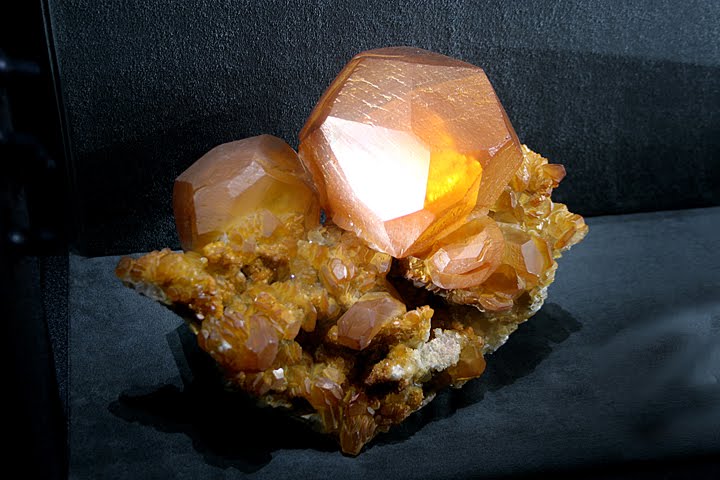
It was the calcite specimen shown in the above picture from the Delta Carbonate Quarry, now known as the York Building Supply Quarry, in York, Pennsylvania. With a main crystal measuring about 4 1/2 inches across, I've never observed a more appealing example of this classic genre. Upon learning from the Delaware Mineralogical Museum Curator Sharon Fitzgerald that its original source was one of my favorite collector/dealers, I immediately decided to contact him.

Eric Meier of Wilmington, Delaware, is pictured at left behind tables of his inventory at the Delaware Mineralogical Society's show this past March. Trading as Broken Back Minerals, he was among the busiest dealers there. Likewise, at the September Gem Cutters Guild of Baltimore Show in the Howard County Fairgrounds, November's Roanoke Valley Gem and Mineral Show at the Salem,Virginia Civic Center, and other East Coast events. He carries substantial regional material. His prices are quite reasonable to begin with and become increasingly so for customers who purchase in quantity.

Eric informed me that a threesome also including his friends Bill Longacre and Joe Hoffman collected this magnificent calcite specimen together in 1993. They were at the bottom of the quarry when Hoffman noticed a small hole about 25 feet up a scalable slanted wall. By chiseling away at the brecciated limestone surrounding the hole, they succeeded in opening up a pocket completely lined with crystals. About eighteen inches high and ten to twelve feet wide, the pocket tapered back approximately eight feet. Once they'd opened the pocket, removing the crystals therein became more difficult. Limestone that was not brecciated surrounded them. The men shoved a blanket into the pocket to protect what crystals they could dislodge, then hammered and chiseled away. When finished, they agreed to divide the booty and rolled dice for first pick. Eric rolled a double six for the piece now in the Delaware Mineralogical Museum. It required minimal cleaning.

Skip Colflesh, whose ruizite find at Cornwall, PA, was the subject of the June 13 Mineral Bliss post, also collected large quantities of calcite at this York locality between 2000 and 2002 in the company of fellow legendary Pennsylvania collectors Bryon Brookmyer and Bob Weaver. Skip authored a well illustrated article about the genre that appeared in the September/October 2002 edition of Rocks and Minerals. In a recent Email to me, he mentioned "crystals up to ~8" and the subsequent discovery in 2003 of a pocket with even more diverse crystals.

The crystals are often twinned or stacked. Sometimes they appear ball-like. Their forms range from rhombs to prisms to scalenohedra. This diversity along with a distinctive orange/ honey/ amber coloration distinguishes them. Similar crystals have been collected at another nearby York Building Supply owned quarry known as the Thomasville Quarry. While both localities have been off-limits to collectors for years, plenty of calcite from them remain available on the market and grace both museums and personal collections.

Saturday, November 28, 2009

Uncovering a Spectacular Maryland Specimen


The above pictured spessartite garnet atop schorl tourmaline is one of two Maryland specimens displayed in the University of Delaware Mineralogical Museum. As I photographed it, the Museum's curator, Dr. Sharon Fitzgerald, informed me that her husband, Dr. Peter Leavens, had dislodged it from a road cut near Elkton. How on earth did he do it, I wondered, and exactly where?

Dr. Leavens is currently Emeritus (retired) Professor of Geology at the University of Delaware, where he taught for 38 years. He was also Curator of the Mineralogical Museum from 1972 to 1997, and is married to the museum's present curator, Dr. Fitzgerald. At her bidding Dr. Leavens wrote up for me what happened. Here is his story:

On the official Maryland state highway map, Appleton is marked as the most northeasterly town site in the state, although there is nothing there except a convenience store at the crossroads where Appleton Road, connecting Elkton, MD and Kemblesville PA, crosses MD 273.

In the mid 1970s I was teaching at the University of Delaware and living in Kemblesville. My commute took me down Appleton Road and into Delaware on 273. One day in late summer I saw that a development road (now North Edgewood Drive) was being built off Appleton Road to the east, a few hundred yards north of the crossroads.


Scouting along the road, I found some large quartz boulders which had been plowed out of the roadbed and piled on the bank. The road had cut across a pegmatite, about four feet wide and at least as long as the road width. Judging from the limited outcrop exposed in the road, the pegmatite had an outer quartz-feldspar zone and a discontinuous quartz core; the boulders on the bank were pieces of the core. What got my attention were the crisp outlines of several black schorl tourmaline and tan microcline crystals embedded in the margins of the quartz core boulders.

I had my sledge hammer in the car, so I got it out and began beating on the quartz boulders, hoping to jar the crystals loose, and I was able to recover several tourmaline crystals and part of a microcline crystal. By far the best specimen is a 2.5" tall schorl capped by two 1" garnet crystals. One garnet, which had not been protected by the quartz, had crumbled almost completely away, but the other is a crisp trapezohedron. One corner of the tourmaline came out in several fragments and had to be repaired, but overall it is a beautiful specimen.

The bedrock geologic map of northern Delaware shows that the northwest corner of New Castle County, including part of Newark, contains abundant pegmatites. During the building of West Branch development in Newark in the 1990’s, a number of pegmatites were unearthed that produced schorl tourmaline, a few beryl crystals, and some small garnets. The Appleton occurrence is only about three miles west of West Branch and may be part of the same pegmatite swarm.

If so there may be other finds to be made in the northeast corner of Maryland. Unfortunately, both the Appleton and the West Branch pegmatites are covered, and no traces of them remain.


Contributed by

Dr. Peter Leavens

Saturday, November 21, 2009

Minerals from the State of Delaware

Delaware surely must yield the least variety of mineral specimens of any other state in the US. That's because a coastal plain consisting of sand and sediment underlies most of it. Delaware's relatively few collectible minerals confine themselves to a diminutive tract of Appalchian Piedmont in the far northwest part of the state.

Delaware's State Mineral is sillimanite. The specimen shown beneath our title was collected at Brandywine Springs. A polymorph of kyanite and andalusite, gemologists refer to sillimanite when gemmy and transparent as fibrolite. I've also heard it called Delaware's State Gem. Give Delaware credit. Half the states in the US don't have a state mineral. Recognize them as well for its first class mineralogical society and the wonderful mineralogical museum at the University of Delaware.

Although the university of Delaware Mineralogical Museum has yet to exhibit Delaware minerals, next door at 257 Academy Street in the Delaware Geological Survey, a cabinet on the second floor features several impressive Delaware specimens. At top left are apatite crystals from Dixon's Quarry in Woodale. Below it are almandine garnet crystals from a no longer accessible locality beneath the homes of a Newark neighborhood known as West Branch. The beryl at top right is also from West Branch; so are the curved schorl tourmaline crystals pictured beneath it. In addition to showing me these minerals and allowing me to photograph them, Dr. Fitzgerald accommodated me similarly with other Delaware material in storage at the Museum.

With the West Branch locality extinct, Wilmington's Brandywine Quarry---not to be confused with the Brandywine Springs sillimanite locality---probably has Delaware's most extensive variety of minerals with 18 entries including 14 valid minerals noted in Mindat. The orange chabazite pictured at left especially impressed me among Brandywine Quarry minerals. Chabazite is one of four zeolites known to occur here along with stilbite, laumontite, and natrolite.

The stilbite pictured at left attracted my interest. It came from a road cut along I-95 near Naaman's Road. And the historic magnetite at right in a sheet of muscovite from Chandler's Hollow (Beaver Valley) in Newcastle County fascinated me. To see images of the the Delaware minerals shown in this post and other Delaware minerals that I photographed during my recent visit to the University of Delaware Mineralogical Museum, please follow the link to this set on my Flickr Site.

Saturday, November 14, 2009

University of Delaware Mineralogical Museum: A Private Visit

As Delaware Mineralogical Museum Curator Sharon Fitzgerald removed the glass encasing this Jeffrey Mine vesuvianite for the photograph, it appeared to me to be as close to perfect as any mineral I ever encountered. Vesuvianite was the topic of Dr. Fitzgerald's doctoral thesis in mineralogy, and she was raving about it. This one room museum in Penny Hall on the University of Delaware campus displays a lot more priceless world class specimens than its small square footage would suggest. Although I typically could overlook a genre so common as dolomite, the specimen pictured at right from Navarre, Spain impressed me almost as much as the vesuvianite. Same for dozens of other pieces here, especially as Dr. Fitzgerald encouraged me to pause and contemplate them. She also noted that the serandite with analcime from Mt. Saint Hilaire, Quebec (top left) and the wire sliver piece shown below it from Zacatecas, Mexico, have graced cover pages of Mineralogical Record.


This personal tour followed an email I received from Dr. Fitzgerald responding to our June 6 Mineral Bliss post heralding the museum's reopening after a long period of closure for renovations. Inviting me to return, she spoke of the "amazing collection that is here and the possibilities that surround it." Since my earlier post was based on an all too quick walk-through, I enthusiastically accepted the offer.


The University of Delaware owns over 15 thousand specimens, about four thousand of which have yet to be catalogued. Its mission is to "display the best" and maintain ample material for study. Since twelve years have passed since the Museum's last targeted acquisitions, Dr. Fitzgerald is on the lookout for material from major recent finds, especially in China. She also plans to de-access hundreds of pieces the Museum doesn't need.


Among other plans is to assemble a display of regional minerals. Presently, about a dozen such specimens from neighboring states grace different cabinets as part of other suites or categories. Most are from Pennsylvania. I suspect that the French Creek chalcopyrite shown at top left and also the Woods Mine Brucite at top right are superior to any other of their genres these classic localities ever produced. The Cornwall andradite garnet at bottom right , which is in a visiting case provided courtesy of David Biers, is also amazing. I've deliberately refrained from mentioning one Pennsylvania specimen in particular to share its story as the sole topic of a future Mineral Bliss post. Of two Maryland specimens, the spessartite garnet on schorl tourmaline pictured beneath the chalcopyrite all but blew away this publisher of the Maryland Minerals website. Dr. Fitzgeralds's husband, Dr. Peter Leavens, who curated the Museum for a 25 year period beginning in the 1970's, collected it in a Cecil County roadcut near Elkton.

So what about Delaware minerals? Though Delaware is hardly a mineral collectors' haven, a few choice specimens including schorl tourmaline, spessartine garnet, and beryl are in a display cabinet next door at the Delaware Geological Survey, 257 Academy St. A wider selection of remarkable Delaware minerals is under lock and key in the basement of Penny Hall beneath the Musuem. I managed to photograph the best from both caches. You can see pictures and read about them in an upcoming post entitled The Minerals of Delaware.

Saturday, November 7, 2009

Jonathan Ertman: Maryland's Mr. Hunting Hill Garnet

Jon Ertman's nickname, "Maryland's Mr. Garnet," recognizes him as the premier aficionado, collector, and dealer to specialize in the grossular garnets from Hunting Hill Quarry in Rockville. Hunting Hill garnets may well have become Maryland's best known and most sought after contribution to the mineral kingdom. Jon's role with them has evolved over the 37 years since he moved with his family as a pre-teen from upstate New York to Rockville. Already a rockhound, he found his way the several miles from his new home to Hunting Hill in a matter of days.

Jon surmises that he's collected at Hunting Hill a couple hundred times. "Before OSHA," he recalls, " you could just sign a waiver at the gate to go in and collect." Today the quarry grants access only by pre-arrangement at specified times exclusively with clubs and groups that carry insurance. Jon is an active member of both the Montgomery County Mineral Society and the Northern Virginia Mineral Society, which share Hunting Hill as their most popular field trip destination. No other Maryland locality yields such a wide variety of minerals, 69 at last count. Hunting Hill is the only Maryland locality for many of these species. Some, such as pokrovskite and xonotlite, rarely occur anywhere else in the world.

Jon also takes pride in his suites of minerals from such no longer accessible Northern Virginia localities as Centreville Quarry, Bull Run Quarry, Luck Quarry, Chantilly Quarry, and Goose Creek Quarry. His collection also holds an enormous quantity of worldwide minerals. They dominate the inventory he sells at regional swaps and shows, although he emphasizes that every mineral in his collection is for sale.

Notwithstanding, Jon's Hunting Hill grossular garnets reign supreme. Displays such as pictured at left are prominent in his sizeable basement. Hundreds of smaller pieces, including plenty of thumbnails, fill flats lining the wall. The crystals typically ocur in a serpentinite-rodingite matrix and sometimes associate with very attractive light green clinochlore crystals. Of all the Hunting Hill garnet pieces in Jon's collection, his favorite is the one pictured at right. For aesthetics and quality, he sees it as representing the best of a classic genre. He'll sell it for $1000. If that's too much for the budget, plenty of very attractive smaller pieces go for less than $10.

Jon has sent some of his Hunting Hill garnets to Thailand for faceting. He charges about $80 a carat for these cut stones and is in no big hurry to sell them. Yours truly may have been among the first to get in on this one. Pictured at right is my wedding ring, in the center of which a Hunting Hill garnet that Jon collected has replaced the original diamond. At present, it's one of but a very few jewelry items anywhere to feature such a stone.

However unusual my ring, I have yet to see any jewelry bearing Patuxent River agate. Maryland's legislature chose this alleged manifestation of silicified dinosaur bone a few years ago as the State's official gemstone. Confident that most Maryland jewelers, geologists, and members of the rockhound community agree with him, Jon Ertman proclaims they should have picked Hunting Hill garnets.

Jon can be reached at grossular9@live.com.

Saturday, October 31, 2009

Beach Pebble Fun in Marin County

Spending the past few days in San Francisco with a busy schedule, I'd anticipated this would be the first week since launching Mineral Bliss last February that there wouldn't be a post. It was a pleasant family oriented trip, however, into which my son Alex and I were able to squeeze in a few hours for a hike. As we scanned his trail book to pick one, I saw "semi-precious stones" mentioned in conjunction with the "Rodeo Beach Hike." Parking to reach the trail was directly at Rodeo Beach. We drove there and headed out, making it approximately two hundred yards to near the shoreline. Thereafter, we were rarely off our knees.

The picture atop this page is of pebbles ranging in size from about five millimeters to one and a half centimeters. It includes a number of less common pebbles that I'm reluctant to identify without help. Most of what's green is serpentine from the serpentinite rocks abundant in the adjacent Marin County headlands. These headlands are also rich in chert that can be gray, green, red, blue, or brown.
Other beaches along San Francisco Bay yield similar pebbles. Pictured at left are a few that my son Alex picked up several months ago across the Bay at Baker Beach, which is within the San Francisco city limits. I first suspected that the red and brown pebble at center right could be an agate, but am now convinced that it's chert or possibly jasper. One of Marin County's beaches is known as Agate Beach. From the Web, I'm told that many grains of sand there are from agates, but that marine fossils are a better bet for collecting than agate.

Serpentinite pebbles from both Rodeo Beach and Baker Beach remind me of the "jade" that I recall checking out years ago at Jade Beach along the Pacific a couple hundred miles south in the Big Sur. At Jade Beach, the stones are are much larger. Some are actually boulders. They are said to be jadeite and/or nephrite. I'd enjoy the opportunity to compare the Jade Beach material with some of these pebbles.

Saturday, October 24, 2009

The Eight New Minerals Discovered by Pat Haynes

Renowned geologist Pat Haynes wears his cowboy hat in trademark fashion at shows, even since moving from Nevada to Northern Virginia. I didn't ask what was in his left hand when shooting the above picture at the East Coast Gem and Mineral Show in West Springfield, Massachusetts, this past August. However, he usually has with him a directory of approximately 4350 mineral species known to exist. Listings of the approximately 2300 of them in his personal species collection bear checkmarks. Eight of them he discovered himself, nine if you count squawcreekite, which he's quick to inform you that the IMA (International Mineralogical Association) discredited in 2003. He's vocal about his penchant for accurate identification, which can be tricky with the kinds of minerals he's uncovered. Seven have been secondary uranium or vanadium minerals from Colorado and Utah, one an arsenate from New Mexico.

An earlier post at Mineral Bliss featured a title shot of the mineral haynesite. In today's post is an image of a more aesthetically pleasing haynesite specimen, perhaps the best in existence. I had never heard of haynesite until months after meeting Pat at John Veevaert's open house last February in Tucson. He was there hawking micromounts and thumbnail specimens, one of which I recall being plumbophyllite, an IMA approved but yet to published new mineral that someone else discovered. Only months later, enticed to undertake some research after observing a haynesite micromount for sale on eBay, did I learn that Pat Haynes discovered not only haynesite, but seven other new minerals as well.

Beginning with haynesite, they are as follows:


Haynesite: I suspect this could be the best specimen of haynesite ever collected. Pat discovered this uranyl selenite in December of 1986 at the Repete Mine in San Juan County, Utah. Now closed and sealed, the Repete Mine is both the type locality for haynesite and the only locality from which haynesite has ever been reported.

Orthominasragrite: This extremely rare vanadium sulfate accompanied by acicular white rozenite was discovered by Pat in a silicified tree fossil at the North Mesa 5 Mine, Temple Mt., Emery County, Utah. It is the orthorhombic polymorph of minasragrite for which the type locality is the Ragra Mine (minasragra) in Peru. It occurs only in crystalline microscopic crusts.
Anorthominasragrite: Also discovered in a silicified tree fossil at the North Mesa 5 Mine, Temple Mt., Emery County, Utah, anorthominasragrite has mever been reported from any other locality. Anorthominasragrite is the triclinic polymorph of minasragrite. In addition to crystalline microscopic crusts similar to orthominasragrite, anorthominasragrite is also known to form lath-like crystals.
Bobjonesite: Pat insisted that this third vanadium sulfate he discovered at the North Mesa 5 Mine remain in its container to be photographed. Named by Pat to honore the eminent mineralogical speaker and writer, and editor of Rocks and Gems, Bobjonesite is stable only in extremely dry atmosphere and quickly hydrates when exposed to air. Because it has only three waters in its structure as opposed to five waters in the other vanadium sulfates, a synthetic equivalent was used during analysis to determine the x-ray powder diffraction pattern.

Blatonite: One of two minerals Pat Haynes discovered in the mid 1990's at the Jomac Uranium Mine, Brown's Rim, San Juan County, Utah, the only locality from which blatonite has ever been reported. An uranyl carbonate (monohydrate), it occurs exclusively in acicular crystals as shown . The name blatonite honors the Belgian crystallographer Norbert Blaton.
Oswaldpeetersite: Another uranyl carbonate found exclusively at the Jomac Uranium Mine, it is named after Belgian crystallographer and uranium mineralogy researcher Maurice Oswald Peters. Oswaldpeetersite is the first known basic uranyl carbonate without additional cations (positive ions) in its structure.

Metamunirite: Discovered by Pat in 1986 at the Burro Mine, Slick Rock, San Miguel County Colorado, this anydrous sodium metavanadate is named for its relationship to munirite and is a product of munirite dehydration. Extremely rare, it most commonly occurs as post-mining efflorescent crusts.

Maxwellite: In 1983, thinking that he had been collecting durangite at the Squaw Creek Tin Mine in Catron County, New Mexico, Pat later learned that what he'd picked up was a new mineral species. The iron analog of durangite, this fluoro sodium iron arsenate, is named for the late Charles Henry Maxwell, a U.S. Geological Survey geologist renowned for his work in New Mexico.

Squawcreekite: Pat uncovered this iron antimony oxide in 1983 at the Squaw Creek Tin Mine at about the same time he discovered maxwellite. In 1991 the IMA approved it as the new mineral squawcreekite. They later discredited it in 2003 as a tin-rich triphuyite. MINDAT refers to squawcreekite as a synonym of triphuyite.


Saturday, October 17, 2009

The 2010 Micromineral Micromount Calendar

Calendars featuring minerals are somewhat obscure. Mineral calendars that feature microminerals are very obscure. Regardless, microminerals are typically prone to more beauty and detail than any other part of the mineral kingdom. For that matter many of the most spectacular species in existence require substantial magnification to be seen. Below are the choices for this year's calendar.


Every page is on sturdy cover weight matte coated stock. Pages measures 8 1/2 x 11 inches closed and 11 x 17 inches open. A very limited number are available at the eBay Store link at the top right of this page. If they sell out quickly enough, more will be printed. If not, they wont.

Saturday, October 10, 2009

Mineral Mastery at an Early Age


Listed below are some of the mineralogical coups credited to 11 year old Jessica of Western Maryland.

  • A link to her photographically illustrated review of the East Coast Gem and Mineral Show is featured on the cover page of Mindat.


  • An exhibit at the Gemcutters Guild gem and Mineral Show in September was a display she assembled of selected minerals from her collection.


  • She has been asked to put together a display of her minerals on the floor of the Tucson Convention Center for the four day "Main" Tucson Gem and Mineral Show, Feb. 11-14, 2010.


  • By special invitation, she spent a day in the mineralogy lab at Penn State working with the scm microscope and "crystal maker" apparatus. The X-ray diffraction scope had broken the day she was there.


  • At the Smithsonian Museum of Natural History she rated a special behind the scenes visit that included entry to its legendary and highly secure "Blue Room" vault.


  • I finally got to meet Jessica and her dad Bob this past weekend at the 53rd annual Desautels Micromount Symposium where she was an active participant amidst numerous international Micromount Hall of Famers and at least two mineralogists who have discovered new minerals and after whom minerals have been named.

This young lady's prodigious quest for mineralogical knowledge (and minerals, of course) traces to a visit with her parents to the Catoctin Zoo when she was two years old. More than the animals, what fascinated her most that day was a granite pebble that she picked up in which was a grain of pyrite. Thenceforth, she became an aficionado of "pretty stones." The interest in identifying them and the related scientific components began about two years ago.


Her father has been with her every step of the way. Together, they take on at least two serious mineral excursions every month, including shows and localities. Among the latter have been the dumps of the Mineral Hill Mine in Carroll County; those of the Allah Cooper Mine in Mineral, Virginia; the Tripp Mine in New Hampshire; and the Jacobs Geode Mine in Missouri. Her "big wish" would be to "get into more localities."


Jessica is an enormous exception to a disturbing trend in mineralogical circles of diminished younger generation enthusiasm for minerals, or for that matter natural history in general. She confirmed to me that interest in minerals is practically nonexistent in her age group and that the handful of young enthusiasts she's met through club circles are a few years older.


Will Jessica's love and fascination for the hobby last? No one is saying. I asked her if she had yet found a "niche." She confessed she hadn't. Rather, by virtue of her age, her engagement with the hobby, and the dearth of others like her, Jessica exemplifies about as important and significant a niche as exists in mineralogy.

Saturday, October 3, 2009

Word from Harvard about Bare Hills Chromite and Magnetite


A month ago, Mineral Bliss posted observations related to Maryland minerals at the Harvard Mineralogical Museum. Of particular interest was a small exhibit of chromite in various habits from different localities. Two of the selections were from Bare Hills in Baltimore County. One was massive chromite with fibrous serpentine. The other was the glass vial pictured above at center filled with minute octahedra about which my comments were as follows:

I would love to know how these crystals were collected. Did they occur as floaters in the soil, or were they extracted from a (presumably serpentinite) matrix? Although massive chromite has always been ubiquitous at the Bare Hills serpentine barrens, crystals are most unexpected.

That expression of curiosity would have been the end of it had not my friend Harold Levey (at left) telephoned to share further thoughts. To Harold, whose collecting experience at Bare Hills spans more than 70 years, the likelihood of chromite crystals having been collected at Bare Hills was every bit as remote. He also emphasized the visual resemblance of the crystals in the jar to magnetite crystals that were ubiquitous on the long built over dumps of the Bare Hills Copper Mine.

Still in my possession are the magnetite crystals pictured at left of the jar that I collected at the Bare Hills Copper Mine myself more than 50 years ago. They typically occurred as pictured in a talc-like steatite soft enough for one's fingernails to dislodge. In appearance they resemble chromite crystals. Pictured at right of the jar is the only example immediately available for me to photograph of crystalized chromite (a micromount from Gabon, actually) . MINDAT has numerous better examples.

I was wary of challenging the identification of anything displayed in such a world class museum. However, encouraged by Harold to do so, I mailed off a letter to its curator, Dr Carl Francis suggesting the possibililty of a discrepancy.

Just two weeks later, a return letter arrived from Dr. Francis. He had researched the history of the specimen and even found its original label from the Leonhard Liebener Collection, which was
purchased in Austria in 1869. While the information on the exhibit label had been correctly transcribed, the crystals, when confronted with a magnet, were mostly magnetic octahedra accompanied by "some rounded black, nonmagnetic (chromite?) grains. " I conclude," Dr. Francis wrote," that the specimen is a mixture that was accepted as chromite by Liebener and hasn't been questioned until your recent visit. I have relabeled it magnetite, attributed it to the Bare Hills Copper Mine on your authority, and retired it from the display."

Thank you Dr. Francis for going to such lengths upon hearing from the likes of Yours Truly, and thank you Harold Levey for the observation that inspired in me the gall to write. As a bonus, Dr. Francis shared additional information about Maryland Minerals owned by the Harvard Museum that are not currently on display. We're hoping for the opportunity to share related information in the coming months.

Friday, September 25, 2009

Coming Up: The 53 Annual Desautels Micromount Symposium

Micromount Hall of Fame Members, Pictured Left to Right:
Dick Thomssen, John Ebner, Sugar White, Phil Evanoff, Cynthia Payne, Dan Behnke, Neil Hubbard, Quintin Wight.

Most of the above Micromount Hall of Fame members and others, including two new inductees, are expected when the Baltimore Mineral Society holds its 53rd Annual Desautels Micromount Symposium on Oct. 2-4, 2009, at the MHA Pierson Conference Center, 6820 Deerpath Rd, Elkridge, Maryland 21075.

Here's what happens: Attendees register just inside the door at a table in a hallway where the walls are lined with dealers selling micromounts and micromounting paraphernalia. At the end of the hallway and to the left is the "giveaway room" where the contents of scores of open boxes full of typically vuggy material, all identified according to locality, are available for perusal and for the taking. To the right is the main conference room, which is lined with long tables and chairs where attendees select spots to set up their binocular or trinocular microscopes. Dinner is served on site Friday evening; lunch is served on Saturday and Sunday. Everyone goes out for dinner on their own Saturday evening. Otherwise, attendees share ideas and information, purchase and trade micromounts, and enjoy the slide shows and presentations.

The first of these events was held in 1957, at the behest of the Baltimore Mineral Society's late Founding President Paul Desautels after whom the Symposium is named. As such, Colonel Quintin Wight, author of The Complete Book of Micromounting notes that the Desautels Micromount Symposium "has served as a model for most of the rest" of the approximate score of other annual micromount symposia that now happen around the world. Col. Wight, who also writes an annual feature "The Year in Micromounting" for Rocks and Minerals, is always an active participant and serves as master of ceremonies for the induction of each year's new Micromount Hall of Famers.

Two new Hall of Fame members will be inducted this year: Marco Ciriotti and the late Vi Anderson. Marco Ciriotti is President of the Italian Mineralogical Association, and an author of the newly published book, Italian Type Minerals. Vi Anderson co-authored Monteregian Treasures: The Minerals of Mont Saint-Hilaire, Quebec and for many years was a well known proponent and contributor to the micromounting hobby.

Various slide shows are scheduled for Friday evening. On Saturday, at approximately 3:30 PM, after the Hall of Fame presentations, Marco Ciriotti will give a presentation entitled "Minerals of the Luserna Stone." At 5 PM, participants go out to dinner at nearby restaurants, returning by 7:00 for two more presentations. One will be by Quintin and Willow Wight on "Gems and Minerals of Russia." Mineral dealer, mineral cabinet maker, and former miner Keith Williams will follow the Wight's with a presentation on "Mining and Minerals of Bulgaria."

On Sunday, at 9 a.m., the Workshop reopens. At 10:30 a.m., Mike Skebo, President of the Canadian Micro Mineral Association, is scheduled to give a presentation entitled: "From Russia: With Memories and Minerals." Lunch will be served at 11:30 AM, and at 2 PM, the Symposium closes. As in recent past years, special recognition is due to Col. Wight, who regularly attends micromount symposia around the globe, and to BMS Officers and Executive Board Members Mike Seeds, Carolyn Weinberger, and Steve Weinberger and Al Pribula, who take on the work and planning that assures this event's continuous stature and success.
Walk-ins are welcome. Admission is $27 at the door. For more information, go to the Baltimore Mineral Society web site.

Saturday, September 19, 2009

Mineralogist's Kitchen Counter Top

Cast concrete counter tops with various items embedded into them are becoming almost as popular as granite. We just had ours created. It features quartz crystals that I collected from tailings in Jessieville, Arkansas, a few relatively spectacular beach pebbles, and numerous water smoothed stones of banded trap rock. We're delighted with our new kitchen counter despite visual differences between the end result and our original vision. These discrepancies were not big surprises, much less disappointments. They resulted when the finished product was polished smooth. This removed approximately 1/16 inch of original counter top, eliminated striations and occasionally altered the outlines of some crystal faces. It also diversified the shapes of numerous trap rock pebbles

One quickly noticeable surprise was how shadows darken a clear embedded crystal even when touched ever so slightly by one's finger. By retaining their original shapes, the beach pebbles, all with diameters of less than an inch, attractively retained their shapes. The trap rock pebbles, on the other hand, which were always larger than the beach pebbles, tended toward a range of eclectic shapes with portions covered by concrete. These eclectic shapes, however, proved more pleasing than had their shapes remained as we had last seen them. They definitely proved an antidote to boredom.

In conclusion, we have a few tips that could prove pertinent helpful to anyone who undertakes a project similar to ours. Very important at the outset is that whatever minerals, crystals, gems, stones, or rocks are used, their hardness should equal seven or higher on the Moh's hardness scale. With respect to minerals, this could pretty much limit you to quartz, garnet, tourmaline, and corundum. Color scheming, which depends upon personal taste, also merits consideration. Early on, I was eager to to contribute about a dozen amethyst crystals and a limited amount of blue corundum sapphire, but Nina nixed it. Instead our quartz crystals were transparent or milky with the exception of a small number of dark grey-yellow citrine crystals. If we'd had some on hand some loose smoky quartz crystals, however, they also would have worked great.

While the trap rock pieces ran a gray scale, The beach pebbles, all translucent quartz, came in hues that ranged from yellowish to brownish, a few with a reddish cast. As effectively as everything worked together, our only regret was not having more of them. And now that the project is complete, I agree with Nina that including any blue, green or purple crystals would have distracted from from our desired level of cohesiveness.

Saturday, September 12, 2009

Carrollite and the Cobalt Sulphides of Carroll County, Maryland


Pictured from left to right: Carrollite from the Patapsco Mines near Finksburg, siegenite-carrollite from the Mineral Hill Mine in Louisville, and linnaeite from the dumps of the Springfield Mine near Sykesville. So state the labels in my personal collection. While the information to back up these identifications have sustenance, only the Mineral Hill siegenite-carrollite identification bears total certainty. For that matter, identification uncertainties plague even the origninal carrollite that derived its name from Carroll County, Maryland, where the Patapsco Mines receive credit as the type locality.

Carrollite, siegenite, and linnaeite belong to the linnaeite mineral group---or series. They occur along with the the more prevalent copper and iron minerals in veins throughout the shists, gneiss, and ultramafic rocks that geologists refer to as the Sykesville Formation. Described in Bulletin #28 of the Maryland Geological Survey, the Sykesville Formation extends "from the Baltimore-Carroll County Line about 2 1/2 miles south of Finksburg southwestward through Sykesville and thence across Howard County."

Carrollite is the most renowned mineral in the linnaeite series. Collectors everywhere treasure the magnificent octahedral crystals from Katanga in the Congo. Maryland Carrollite, though nowhere near so visibly spectacular, is difficult to come by on the market and likely to command top dollar wherever and whenever it appears. Any remote chances of field-collecting carrrollite at its type locality were removed by the folks who fenced off, posted, and then buried the last remaining dump from the Patapsco Mines beneath tons of heavy trash.

Questions have arisen over many years regarding whether the mineral discovered at the Patapsco Mines that became known as carrollite was not in fact linnaeite with copper impurities contributed by grains of associated chalcopyrite, chalcocite, and bornite unwittingly included in the grainy mix being tested. Johnny Johnsson's feature about the history of the Patapsco Mines and the discovery of carrollite, published during the summer of 1998 in the late Jay Lininger's Matrix Journal, states that "significant doubts linger as to whether carrollite actually exists in the Patapsco Mines where it was initially 'discovered." More than a century’s worth of testing Maryland's carrollite, siegenite, and linnaeite have demonstated extensive gradations in chemical composition amongst all three minerals, particularly with respect to copper content.


Let's return now to the specimens pictured above and the cases for their identification.


  • Carrollite from the Patapsco Mines: Once part of the Neil Wintringham collection, I purchased this specimen for $77 at auction on eBay. The label naming Sykesville as the locality was probably a generalization. The presence in the rock of malachite (possibly brochantite) and chalcocite was typical at and probably unique to the Patapsco Mines (Finksburg, Wildesen, or Orchard). The grayish black chalcocite, in fact, would seem to have replaced much of what may once have been bright shiny silvery colored carrollite.
  • Carrollite-siegenite from Mineral Hill Mine: The Mineral Hill Mine is the only locality where the composition of "carrollite" was ever found to include nickel along with cobalt and sulphur. I obtained the specimen from Fred Parker, a stickler about accurate identification, which he personally verifies based on x-ray diffraction and microanalysis. Interestingly, Joseph Vadjke once showed Parker an end-member Mineral Hill Mine carrollite specimen that had been analyzed in Czechoslovakia.
  • Linnaeite from the Springfield Mine: I found this when breaking up a rock from a small rock pile adjacent to the foundation sitting uphill from the main Springfield dump. My confidence was boosted upon reading in Lawrence R. Bernstein's Minerals of the Washington D.C. Area of "cuprian" linnaeite in"silvery to pinkish-gray metallic masses" as the only cobalt bearing mineral named from the Springfield Mine. Upon showing the piece to Fred Parker a couple weeks later and being told: "Yes, that’s linnaeite," I became convinced.

Finally, we have not mentioned a fourth cobalt bearing mineral known to have occurred at these localities, namely cobaltiferous gahnite. Mineral Bliss has that story on the backburner.


Saturday, September 5, 2009

What is this?


Zoom in and the trays reveal crystals featured in Mineral Bliss's second post ever from Feb. 15, 2009, about collecting quartz crystals at the Ron Coleman Mine in Jessieville, Arkansas. Accompanying the crystals are various other rocks, pebbles, and crystals that I, and occasionally my wife Nina, have brought home in recent years. Bringing too much stuff like this into the house and having it usurp space where it's unappreciated is a collector's curse.

Look closely and observe that regardless of colour, every piece bears a dark spot. That's glue resembling tar with which the display! sides of the stones have been attached to the bottom of the tray. The next step will cover them with cast concrete that wont stick to the trays with any more strength than the black glue. When the cast concrete settles and dries, the trays are overturned, their content emptied. The stones imbedded in cast concrete at the bottom of the tray now become the surface of the countertops for our newly remodeled kitchen.

Within the context of Nina's and my standard of living and especially considering the awful present economy, this project is high-end out of all proportion. That's probably because it is one of the few ideas for a "major undertaking" that we both embraced from the git-go with equal levels of enthusiasm.

Though Nina and I credit ourselves with the vision for this countertop, we've entrusted the end-product's creation to Lukeworks, a Baltimore-based design-build manufacturer of products for contemporary spaces. It is a shop where the craftspeople and even the workmen hold arts and artisan degrees that relate directly to what they assemble and create.

Neither Nina nor I---nor for that matter anyone at Lukeworks---has ever seen a countertop quite like we anticipate will be dominating our kitchen in just a couple of weeks. We've seen cast concrete countertops with other kinds of items imbedded, but never crystals or rocks. Expecting soon to have the penultimate mineralogist's kitchen countertop, we'll post pictures when it's installed.

Saturday, August 29, 2009

Maryland Minerals at the Harvard Museum

Never has a display of minerals rendered me so spellbound as the Harvard Mineralogical Museum in the Harvard Museum of Natural History at 24 Oxford Street, Cambridge. Some displays seek primarily to grab the attention and interest of the general public. Others seek mainly to educate. Many want to dazzle and amaze if they have the goods. Created from a frame of reference for education, research, and public display, the Harvard Mineralogical Museum does it all, albeit with but two specimens from Maryland.

The Harvard Collection is old school. Its main room consists of rows of ancient chest-high glass-topped wooden cases with the minerals displayed beneath them. The minerals, usually hand-sized, rest atop a rustic looking muslin fabric that's not always well-vacuumed. Upright glass cases with larger specimens hug the surrounding walls. The minerals are arranged systematically according to chemical composition.

My first Maryland observation was a small clear glass dish of octahedral chromite crystals from Bare Hills, where chromite was first discovered and recognized in the United States. The container of crystals was displayed amidst specimens of chromite with different morphology and habit from other localities. Once part of the L. Liebener collection, they were probably assembled in the first half of the 19th century. I would love to know how these crystals were collected. Did they occur as floaters in the soil or were they extracted from a (presumably serpentinite) matrix? Although massive chromite has always been ubiquitous at the Bare Hills serpentine barrens, crystals are most unexpected.

The other Maryland specimen that I observed was massive rockbridgeite within a concretion. It was collected at Greenbelt in Prince Georges County. This particular specimen fascinated me because my personal collection features a similar piece from this locality that I obtained a couple years ago through Fred Parker. Just like my specimen, it bears additional brownish phosphate minerals. They could include dufrenite, kidwellite and beraunite, a combination once known as laubmanite, a discredited mineral. Leaving such considerations to the Museum’s research and education components, the label heralded only the gray-black rockbridgeite, which like crystallized chromite, is not often contemplated as occurring in Maryland.

The Harvard Mineralogical Museum's web site notes that about 4,000 minerals are on display. This seemed like a lot unless I missed something, which I did, because the entire collection exceeds 50,000 specimens. Most are arranged paragenically instead of systematically and are housed in "readily accessible drawers." With over 4,000 specimens from the Franklin,New Jersey environs, and 7,000 New England pieces, it’s likely that Harvard has additional Maryland minerals. What a treat the prospect of snooping through those drawers. Next visit, additional time will be available, and I'll have researched the protocol.

Wednesday, August 26, 2009

More on Manham


CERUSSITE CRYSTALS (MICRO) self collected at Manhan Lead mine dumps, Loudville, MA


Our immediate past post regarding my solitary hour long stop at the Manhan dumps attracted more readers than any previous Mineral Bliss post. Depending upon when read, its content varied. That's because we shortened the original post by cutting all photographic and editorial reference relating to two finds: One was a micro-glob I'd surmised was pink cerussite, the other possible anglesite.

An email from the Editorial Board at Mindat led to my decision regarding these cuts. They were in touch quite quickly to inform me: "Your photo may not be the mineral you said it was." Prompting that quick response, perhaps, was that I'd credited a visual resemblance to photos that were posted on Mindat as the primary source of my identification, noting as well (thankfully) that these identifications were tentative. Mindat's position regarding the "anglesite" was it looked "more like growth-inhibited quartz." Regarding the "cerussite," the editors stated: "It doesn't look like cerussite at all."

I returned to my microscope and box of Manhan rocks and very quickly determined that regardless of issues relating to my "anglesite" identification, Mindat was correct about the cerussite. Within minutes, it became obvious that despite the visual resemblance of my photo to the one that had been pictured at Mindat, the pink glob wasn't cerussite. When poked with a hardness pick, it quickly disintegrated into micro-particles that more suggested an organic substance.

But alas, within a few seconds, I spotted on the same rock a vug in which a sparkle demonstrated renewed promise. After placing the rock under my scope, nearly half an hour of moving and manipulating the rock as well as two fiber optic lights were necessary before the angle I was looking for could be captured. The resulting photo is beneath this post's title, and my confidence level is quite high that no one will question the cerussite identification. I feel just as confident that within a period of time I'll uncover from within my knapsack a rock bearing a no questions asked genre of anglesite as well.