Saturday, August 7, 2010

Back to Asheville and on to Little Pine

My first order of business on Saturday, July 24, was to maneuver through the ongoing merriment in the streets of Asheville to visit Rusty James at the Cornerstone Minerals tent. It was on the sidewalk less than a block away from the Cornerstone Minerals store at Lexington and Walnut. The jewelry here along with plenty of relatively inexpensive rough gems and minerals, some with metaphysical connotations, was selling brisquely. They were in a different league, however, from the ajoite and papagoite included quartz crystals from the Messina Mine, Limpopo Province, Transvaal, South Africa, that Rusty had waiting for me to check out down the street at his store. He was too busy to leave his tent right then, which worked out just fine. Mad Tea Party was playing "ukebilly" music but two blocks away at the Haywood Stage. That's Ami Worthen, Asheville's ukelele rock star, in the picture at right.

Two hours later, enough people were staffing the Cornerstone tent for Rusty to accompany me to the store, which was almost as busy as the tent had been. From under the counter he pulled out several flats from which I purchased two small ajoite included crystals , one loose, the other in matrix. both relatively free of the difficult to remove white material that frequently encrusts them. Rusty has been to South Africa four times to purchase crystals from the owner of the mine. On his most recent visit this past December, he received permission to dig and believes he's the only American ever granted that privilege. Ajoite and papagoite included quartz crystals occur nowhere else on earth. They command astronomically high prices that could go much higher, and Rusty questions how much longer the Messina Mine wil be able to continue producing them.


With business to deal with back in Baltimore on Tuesday, I left Asheville on Sunday early enough for a visit to the renowned Little Pine Garnet Mine (almandine), in Haywood County approximately 25 miles northwest of Asheville. Rick James Jacquot's book Rock, Gem, and Mineral Collecting Sites in Western North Carolina provided good directions for getting to the parking area for the mine on Robert's Branch Road. Immediately past the parking area, the road forks. Blocking the road heading left was a sign stating that the garnet mine was closed and could be visited by appointment only. Therefore, I followed the main road to the right hoping to reach some dumps the book had mentioned and soon found myself heading up the driveway to the home of a farmer. A third road, overgrown enough this time of year that its presence hardly seemed apparent at first, heads from between the other two roads 100 yards into the woods to these dumps. Once there, I managed to dig from the top three inches of pleasingly soft soil a few loose crystals similar the one pictured below at right.

To make arrangements to visit the Little Pine Garnet Mine, collectors should first go to the Sandy Bottom Trail Rides establishment reached by turning from Little Pine Road onto Caney Fork Road a short distance north of its intersection with Roberts Branch Road. The people there couldn't have been nicer. After I signed a waiver, they readily granted me permission to visit the mine.

Without so much as a flashlight, I did little more than stand at the entrance to look inside the mine. My impression was that even with proper equipment, going in further could be problematic for one without experience. Every inch of the walls and ceilings that I could see had been worked and showed markings where crystals had been extracted. Rusty James' associate Greg, pictured next to Rusty and wearing a blue T shirt in our image from the Cornerstone minerals tent, had informed me that as recently as two years ago, he had chiseled some attractive crystals from the walls of a little "crow's nest" just above and to the right of the mine entrance. Perhaps not for the younger and surely more limber Greg, but for the likes of me, attempting to climb up there and whack away with a sledge hammer and chisel could very likely spell big trouble. Therefore, I opted instead to crawl around and dig amidst the schist and soapstone in the dumps immediately adjacent to the mine. While unsuccessful at locating any appealing crystals, either loose or in matrix, I found significant amounts of the kind of rough almandine once mined there to be ground into sand and used as an abrasive for industrial purposes. At different times, the site is said to have been mined for this kind of material as well as gem garnet.

The Little Pine Garnet Mine remains a popular spot for collectors prepared to work underground (or perhaps in that "crow's nest" that Greg mentioned) and willing to undertake a lot of extremely hard work. At this point, I would be curious as to the quality and quantity of what they are able to collect.

Sunday, August 1, 2010

Asheville and Beyond

The Colburn Museum in Asheville, North Carolina was closing for the the next three days in deference to the surrounding gleeful madness of Bele Chere. That was why I beelined it to town via the Blue Ridge Parkway in deference to the joys of digging at one or two of the numerous collecting spots along the more curcuitous route. In early June, I'd snail mailed the Colburn to question whether the straw colored inclusions within the polished quartz stones pictured at left were really cacoxenite. My contention was that they were not cacoxenite; rather they were goethite. It would appear that either they ignored my letter, or I was wrong.


The dubious inclusions are most prominent in the smaller piece at the top, less so in the rounded stone below it. The lower one appears to be material often touted within the metaphysical world as "super seven," and frequently said to bear inclusions of lepidocrocite and various other minerals. Never mind that The Book of Stones by Simmons and Ahsian credits goethite with "past-life recall, connection with Earth, healing through grief, enhanced soul life, and artistic creativity." I should mention that regardless of labeling, both stones are attractive, and nomenclature should have little bearing on their value. My interest in them arose after purchasing a "cacoxenite in quartz" brooch for my wife this past February from a huckster at Electric Park in Tucson.


The following day, Friday, with temperatures hovering near 100 degrees, I left Asheville and Bele Chere to drive 60 miles to Franklin, North Carolina, which was just as hot, to visit its 44th Annual Gemboree. As in the past, this event features four locations quite close to each other. Much as we described it this time last year in Mineral Bliss, it featured few dealers not oriented entirely toward jewelry, gems, and lapidary rather than minerals. At the outdoor location across from the indoor one in the Macon County Community Center, however, I was fortunate enough to find one dealer with an eclectic selection of mineral specimens from old collections at appealing prices. The smithsonite from the 79 Mine near Hayden, Arizona ahown at right is one of several items I purchased from him. It's an old-timer, collected 31 years ago in 1979. Although the dealer knew as well as I did that apple-green (rather than darker green) crystalized (rather than botroydal) smithsonite from this locality is known to be very dear, he was kind enough to sell it to me as part of a volume deal for an extremely attractive price.

My late afternoon arrival back in Asheville allowed for time to catch the Trainwrecks playing their unique version of "dirty funk" at a stage just a block from my hotel. From there it was a five minute walk to Limones at 13 Eagle Street to sip a Maya Margarita made with mezcal, tamarind juice, orange juice, and cointreau followed by a plate of seabass with parsnip puree, haricot vertes, mango salsa, and passion fruit chipotle sauce. I then passed on dessert to walk two blocks south to catch Southern Culture on the Skids close down the day's entertainment.

The next day (Saturday) and night, I spent in Asheville, before leaving the merriment behind on Sunday in time to visit to the Little Pine Garnet Mine in Madison County about twenty miles northwest of town. The next Mineral Bliss post will cover those two days.

Monday, July 26, 2010

A Quick Drive from Baltimore to Asheville

Much like Jazzfest in New Orleans the end of April, so Bele Chere in Asheville has become my favorite late July destination. My preferred manner of transportation to both cities is to drive---from Baltimore. Doing so provides a rare opportunity to sit still, listen to music, photograph appealing scenery along the way, check out interesting restaurants, and especially make a stop or two related to minerals.

As time permits, I like to spend as much time as possible first on the Skyline Drive and then the Blue Ridge Parkway. Enhancing my trip down the former was a glossy gift shop book entitled Geology along Skyline Drive: A Self-Guided Tour For Motorists, by Robert L Badger.

This book included a trail loaded with remarkable geological phenomena and afforded a great opportunity to monitor the extent of my recovery from last year's hip replacement. It was the 1.2 mile Bearfence Mountain loop with its awesome but reasonably safe rock scramble. Setting out from a trailhead at Mile 56.4, the first several hundred yards reveal rocks that quickly change from sandstone to phyllite to conglomerate to quartzite, until metabasalt takes over just before the scramble begins.

That's where some columnar metabasaltic joints, which curiously head out in two different directions raise questions regarding how they were formed millions of years ago. The Bearfence Mountain summit with its wonderful views and numerous comfortable perches for enjoying them is about a third of the way through the scramble and as far as some opt to navigate. Beyond the summit, the oppotunity to scramble continues in a southerly direction blazed by blue markers until reaching the Appalachian Trail.

Along the way, a volcanic breccia covers much of the metabasalt. Within the breccia are occasional air vesicles filled with minerals said to include feldspar, hematite, epidote, quartz and chlorite. Visually, they could almost pass for weathered black garnets.

After Bearfence, I next stopped at Mile 74.5 to check out the slickenlines and a few relatively colorful epidote pods adjacent to the Loft Mountain Overlook pulloff. My Skyline Drive geology book described slickenlines as "parallel lines or narrowly spaced shallow grooves formed by the movement of one mass of solid rock over another---commonly found on faults or in zones where the rocks were stressed." They were easy enough to find, and an example of what they look like is shown at left.

  The epidote pods, at least colourful ones, required a bit more searching Though epidote is common in this part of the Blue Ridge, its presence is often obscured (unless you bust open rocks) by lichens, moss, dirt, and general weathering. The most colourful example I was able to find without breaking open any rocks is shown in the photo at right.

Arriving in Roanoke early enough for dinner meant having to leave Skyline Drive about 50 miles further along before it becomes the Blue Ridge Parkway and then speed west across I-64 for about ten miles then southwest down I-81 for another hundred or so. My dinner was apt reward for this effort. Traveling solo, I ended up sitting at the bar in the Metro Cafe, one of Roanoke's more upscale and envelope pushing dining establishments. What really impressed me---I used to blog about exotic food before moving on to minerals---was that its appetizer menu featured chicken feet. Chicken feet are common fare in New York's or San Francisco's Chinatowns, but even in these cities I have yet to observe them on the menu at a "new American" style restaurant such as the Metro. Messy for sure, and I had to request a finger bowl, but what a great prelude to the BLT featuring pancetta and heirloom tomato slices that followed.

The next morning, inspired by the Falcon Guide book, Best easy day hikes: Blue Ridge Parkway by Randy Johnson, I departed Roanoke via the Blue Ridge Parkway to explore the Rock Castle Gorge hike. Its trailhead is reached by turning left from the Parkway on VA Route 8 at Milepost 165.3 and heading downhill to turn right on VA Route 605, then driving to where it dead ends. Attracting me to this hike was the following quote from Randy Johnson: "Sycamores and copious quartz outcrops are everywhere (the six sided quartz crystals prevalent here reminded residents of castle towers, hence the name of the gorge)." The section of the trail noted for its sycamores and quartz outcrops, however, left me somewhat underwhelmed and hardly enthusiastic about looking for a place to dig. Blame it if you will on a heavy cover of forested vegetation. Soon after returning to my car and reaching I-81, I observed quartz outcroppings that really did seem to be everywhere in the in hilly open fields to my left. Tlhough tempting locations in which to dig, doing so would entail parking illegally along the ramp of this major interstate, climbing a barbed wire fence, trespassing, and moving earth on someone's property in the presence of a myriad motorists, some of them surely police.

Asheville was still 200 miles away. By dark I was checked in at the Skyland Inn near Little Switzerland at Milepost 331. Close by is the North Carolina Mineral Museum, which features mining history much more so than minerals and their localities. Also nearby are resorts, gem oriented gift shops, a couple of salted "gem mines," and some great views. I stayed at the Skyline Inn, an older and somewhat rustic establishment, which comprised all these things in one package along with restaurant and a tiki bar.

Although the Little Switzerland area is completely tourist oriented, the route from here to Asheville along Routes 226 and then 19E passes near more varied and accessible mineral collecting localities than does any other stretch of highway I'm aware of in the United States. There are at least a dozen places to collect, and all the information needed to find them and know what to look for is in the book Rock, Gem, and Mineral collecting Sites in Western North Carolina by Richard James Jacquot, Jr. Depending on the amount of walking necessary, combing two or three of these localities in a day should be realistic. At some point, perhaps this fall, I look forward to returning for a week to check out as many as possible.

The more direct route to Asheville that I took continues to follow the Blue Ridge Parkway. Its scenery is breathtaking in spots, and along the way, a 1.2 mile roundtrip hike to to the Craggy Pinnacle summit from the parking area at Mile 364.5 proved to be an inordinately pleasant a leg stretcher. Aware of 98 degree temperatures in Asheville, my stroll through quasi-Arctic vegetation to a vista where with 360 degree views and 65 degree themperatures couldn't have been more pleasant. Asheville was next. The rest of my trip will be chronicled in the next Mineral Bliss post.

Sunday, July 18, 2010

The Masters Mineral Gallery and More

Long on my mind has been to make the trip to Elizabethtown, PA, for a visit to the Masters Mineral Gallery in the new Lyett Wing of Elizabethtown College's Masters Center for Math and Engineering. It is part of the legacy of Frank Masters, the renowned construction engineer and mineral collector, who funded the building itself and provided numerous specimens from his personal collection for its mineral gallery. Though mineralogy doesn't much figure into the cirriculum at Elizabethtown College, its mineral gallery is delightful space in which to linger.

Walk down the steps from the adjoining lounge area with its comfortable furniture, and sensors light up the elbaite-included quartz from Minas Gerais in the nearest exhibit case. This is one of five free-standing cases. The others each showcase one or two relatively large specimens. The largest holds a three foot cluster of Arkansas quartz crystals. Amethyst geodes and specimens bearing quartz, calcite, and fluorite inhabit the other free-standing cases.

Four much larger wall cases hold the majority of the collection. One case is devoted to different varieties and habits of quartz, another to fluorite. A case filled with worldwide minerals includes a list of the chemical compositions of each species therein both in writing and symbols. Most interesting to me was the case of Pennsylvania minerals. Some of them, for instance the orangish brown nodular goethite from Franklin County, I found to be quite spectacular. Others, such as the Phoenixville pyromorphite, impressed me significantly less.

Regretably, I missed and then learned later about the fluorescent case where at the push of a button, light changing from incandescent to longwave ultraviolet to shortwave ultraviolet cycles over the minerals within. Against a far wall were two more cases, one with a selection of gem materials polished into more spheres, bowls, and eggs than allowed room for labels. Another, devoted to paleontology, featured material ranging from petrified wood to dinosaur eggs.

My favorite aspect of the Masters Gallery was its inviting feng shui. Conveniently, John S. White, the former Curator-in-charge of the Smithsonian's Division of Mineralogy, played a major role in planning, organizing and developing the space, lives halfway between the Gallery and my home in Baltimore. By taking him up on an earlier offer to stop by if in the area, I soon found myself where the feng shui was yet more pleasing. Here the focus was less on the placement of minerals than space for gracious living surrounded by magnificent flower gardens. The neatly kept areas where John and wife Merle, who's Editor-in-Chief of Lapidary Journal, nurture vocation and avocation are present but not apparent.

Later over dinner with John and Merle at a the Blue Heron, a new French bistro in York, PA, John summarized some highlights of his role in developing the Masters Gallery. He related how years earlier, when in London, he had disliked the metal and glass encased mineral display at the British Museum enough to rant about it in an article in Mineralogical Record (of which he was founder and original publisher). That the Masters Gallery also has cabinets of metal and glass reflects John's acumen regarding mistakes to avoid when working with these materials. Another important feature attributable to John is how the minerals in the wall cases are displayed on "steps" covered with fabric to which velcro bottomed labels comfortably attach. John also held forth on the ingenuity of mounts used to display the specimens. They were fabricated by David Graham.

Though not remotely comparable to the number of mineral displays with which John is familiar, I have seen enough of them to form judgmental, if not highly knowledgeable impressions. Many are too cluttered, a few too sparce. Some of America's most renowned exhibits are lighted inadequately to be appreciated. I do not know of an exhibit where the minerals are displayed in a fashion that pleases me more than at the Masters Gallery.

Thursday, July 8, 2010

Beach Reading and Catching Up

Not enough time to read? Give up something to find the time? Is it practical and feasible to do so? Not always. The past couple of summers, a week at the beach has proven for me to be a great opportunity to catch up.

It's that time again, only this year we're not at the beach. Meanwhile, two stacks of reading material neatly piled up on the floor in the corner of my office had both reached a height of over a foot. I recently knocked a couple of inches off by removing about a dozen Mineralogical Record's with articles I had been waiting to revisit.

For a few months last year, Mineral Bliss offered a podcast that attempted to briefly summarize the contents of Mineralogical Record and Rocks & Minerals soon after they arrived through our mail slot. To produce this podcast in a timely fashion, I found myself skimming through these periodicals and moving on before enjoying them in the manner for which they were intended. Ultimately, the podcasting went by the wayside.

Any beach time this summer will not be long enough in any one place for very much reading. However, finding myself with an unexpected block of time during the relentless heatwave that is baking Baltimore, the confines of a well air-conditioned office proved more appealing than nearby beaches for revisiting some of the features in Mineralogical Record that most intrigued me over the past several years going back to July, 2007.

Here are a few highlights:

  • I've long enjoyed Wendell Wilson's editorials in Mineralogical Record. The one that left the strongest impression was entitled "Photographs: A Priority for Museums" from July-August 2007. It ranted about the myriad specimens stashed away at various museums, never to be seen, admired, studied or researched. Is this what those who donated or bequeathed them intended? Or is it what the museums intended by accepting them? Wilson makes his point as to the value for all concerned that phtographic documentation can provide. Is it that the museums lack the time or human resources? Give me a place to stay and a couple of unwanted specimens to take home, and we can talk about it.

  • Most collectors have their varied quirks and niches. Vintage micromounts are one of mine. What a pleasure once again to drool over the pictures and re-read the article in the March-April Minrec by Wendell Willson, Rock Currier, Carl Francis, and Sugar White: "George Washington Fiss (1835-1925) and his micromount collections."


  • The "American Mineral Treasures Issue" of June, 2008 recalled some great memories plus a lot I'd missed when an emergency on the home front mandated an early departure from that year's Tucson Show, which was one of the best, perhaps the best ever. Of course, now both a book as well as a movie have been produced about this amazing exhibit of the known best minerals from the 44 greatest localities in the United States.

  • The five part series spanning Mineralogical Record's last two editions of 2008 and first three of 2009 by Rock Currier entitled "About Mineral Collecting" is in my opinion a masterpiece. It covers all the bases of the hobby and the different kinds of players involved in it. No way I ever could have described myself as accurately as Rock did, even though we'd never met.

  • Being from the East Coast, I particularly like the way Mineralogical Record has kept readers abreast of productive localities in New Jersey. There was the Wendell Wilson piece with amazing images from May-June 2007 regarding the magnificent zeolites being collected at Millington traprock Quarry in Somerset County. More recently (November-December, 2009), and soon thereafter (March-April, 2010) appear picture packed articles(zeolites once again) by Frank A. Imbriacco, II covering the Braen Quarry in Passaic County and the Fanwood Quarry in Somerset County. With so little---at least that I'm aware of--- coming out of the classic Northern Virginia localities once known for similar material, it's great to know about recent action in New Jersey.

My next day-long read will lighten the piles in my office by about the same number of Rocks and Minerals editions. If the heatwave continues, this will probably happen sooner rather than later.


Wednesday, June 23, 2010

Remembering Larry Krause

Baltimore, Maryland lost its premier mineral dealer and a lot more with the June 2 passing of Larry Krause. Just about every local collector was both a customer and a friend. Dealing minerals was only one of the many hats Larry wore. Most of them extended far beyond the interests that bind us mineral people together. Regardless of the hat he was wearing, what most lingers in the memory is of Larry himself and the spirit that drove him. He was gentle, kind, opinionated, motivated by challenges, driven by ethics, civic-minded, cultural minded, good-humoured, and he had a great marriage.

Larry and I go back nearly 33 years, most of which had nothing to do with minerals. My earliest memory is when he as publisher and Alice as editor---they would marry five years later---engaged me as a writer for the Baltimore Chronicle. We spent many hours together over weeks, months, perhaps even a year before Larry mentioned that he collected minerals, which had been my hobby as a child. Soon thereafter, he took me to collect iridescent siderite at Arbutus Canyon along Washington Boulevard (long since paved over by Home Depot). As enjoyable as the experience was for me, a lifestyle encompassing two jobs, two children, and two acres precluded me from resuming this hobby that had been all but forgotten for 25 years.

Larry had a lot of other responsibilities as well during this period. They included publishing at least five community newspapers, two magazines, and a book. He also founded two nonprofits, and had prominent roles with more than several other organizations, among them the Baltimore Mineral Society, which he served at various junctures as secretary, vice president and president.
I stayed in touch with Larry, writing for four of his publications and serving on the boards of directors of two of them. In 1989, I began writing a weekly column entitled "Jake About Town" for the Chronicle. It related to everything that was offbeat about Baltimore's culinary scene.

"Jake About Town" became so much a part of my life that in 1992, I sold the home service brokering business which had been my livelihood for 21 years and launched a company to produce a line of extremely exotic canned soups. Though the soup business never made me rich, it replaced the worries associated with responsibility for thousands of jobs taking place in peoples' houses every year with a level of happiness and a sense of fulfillment I'd never before known. Were it not for Larry, this probably never would have happened, and I mention it only because of the role he played in getting me back into minerals, which became the next chapter.

During the final decade of his life, Larry gradually transitioned from publishing community newspapers to devoting more time to his mineral collection and Octahedron Minerals, the sideline business started years before. It wasn't long before the enormous two-room basement of his and Alice's house was filled with minerals from floor to ceiling. His personal collection was in one of the rooms, Octahedron's inventory in the other.

Around the time I sold the soup business in 2004, to earn more money in real estate and start thinking about retirement, Larry invited me to accompany him to a meeting of the Baltimore Mineral Society and encouraged me to purchase some minerals from him. By this time, I was telling people that minerals were "something to pursue when I get older." Though my life continued to be crammed with other commitments, Larry had soon sold me enough minerals to justify creating a space in the basement to display them. Shortly thereafter, the childhood passion that 45 years before had given way to sports, girls, and other adolescent distractions reinstated itself full force.

After learning that he had cancer, Larry began to sell off in earnest the inventory of Octahedron Minerals as well as his collection. He did so mostly by inviting specific collectors, usually in small groups, to come to the house and shop. Though receiving more than my share of invitations, and wanting to be there, I was out of town on most of these occasions, but recall all too clearly the one that I resisted. Our house already had more rocks in it than we had appropriate space for, and I wanted to see more of them moving out---a slow and tedious process when selling them on line---than coming in. How secondary that concern proved to be when realizing now the opportunity I missed to have had just a little more time hanging out with Larry.

Saturday, June 19, 2010

An All But Forgotten Maryland Gypsum Find

Among the most spectacular mineral specimens known to have been collected in Maryland are the blades and rosettes of gypsum (referred to as selenite when crystallized) that have been plucked from clay along the St. Mary's River banks at Chancellors Point and at Fort Washington in Prince Georges County beneath the bluffs of the Potomac. Lesser known, arguably more spectacular, and all but forgotten are crystals collected approximately 50 years ago from a deposit near Fort Foote in Prince Georges County about three miles down river from Fort Washington. For the second recent Sunday afternoon, a row, I had the opportunity to accompany Jeff Nagy on another drive to Virginia, this time to Strasburg for further research on his project to update and republish the 1981 Maryland Geological Survey publication Minerals of the Washington, DC Area by Lawrence Bernstein. Specifically, his mission was to meet and learn about the find from Gary Allard, who with his brother Brian, now deceased, had discovered the deposit.

For its year and a half of productivity, the site was the secret domain the two brothers. Gary appears in our title picture holding a rosette and the most spectacular crystal blade of the find, which is the largest crystal of selenite I've ever seen from Maryland. Amazingly, its appearance suggests that it could once have been part of a rosette. It is the same crystal that Gary was photographed holding 49 years ago in an article entitled Crystals by the Ditchful that appeared in the June-July, 1961 edition of Rocks and Minerals . At present, we are awaiting permission from Rocks and Minerals new publisher to post a reproduction of that earlier picture. If granted, one will be inserted herein soon thereafter.

Over less than two years, the two brothers pretty much cleaned out most of the crystals, using some for a science project at school and selling a others to classmates. Then they notified Ellsworth Swift,who authored the article in Rocks and Minerals. By then, the ditch had become less a source of crystals than what Swift referred to as "a challenge to discover the nature of the deposit and a chance to speculate on its formation."

He noted in the article that the Fort Foote crystals occurred in the Patapsco Clay, which also hosted other gypsum finds reported from the region. He described this clay as formed in the Cretaceous Age and variegated (in colour). Gary Allard recalled that the crystals occurred in a a "purplish" clay that was darker than the crystal bearing Patapsco clay at nearby Fort Washington. The crystals that Gary and Brian collected, whether rosettes or single crystals, were generally larger and less stained by clay than most of the better known material collected at Fort Washington and in St. Mary's County.

Particularly interesting was that while riverside bluffs had yielded the Fort Washington and St. Mary's crystals, those from Fort Foote were collected about a half mile inland in a ditch intended for drainage alongside what was soon to be paved over as an extension of River Bend Road. Just as noteworthy was their confinement to a 125 foot section of the ditch. Swift suggested that this could mean the crystals "concentrated along structural features such as joints," or that this particular deposit was "irregular in shape with the ditch merely cutting a cross section through the crystal patch.'" He explained further how the crystals were most likely formed when groundwater from the Piedmont that contained sulfuric acid from decomposing pyrite flowed eastward and mixed with the lime bearing beds of the Coastal Plain at Fort Foote.

Gary Allard now lives in the Shenandoah Valley near Strasburg, Virginia. He said he moved there because it had more kinds of rocks than than "that boring Coastal Plain" where he grew up." He still loves to collect minerals and prior to his recent retirement was a jeweler and metal engraver. One of his recent finds that amazed Jeff and me was the green quartz crystal pictured at right from near Front Royal in Warren County, Virginia. The book Minerals of Virginia, by R.V Dietrich, 1991, noted nothing like it from Warren County. The only green quartz the book mentioned was presumably massive and from another part of Virginia with coloration "probably due to included amphibole or chlorite." It too, Gary discovered along the side of a dirt road albeit not in a ditch.

Monday, June 14, 2010

Collecting at the Havre de Grace Quarry

Hats off to the Vulcan Materials Company/Arundel Corporation, except for hard hats that is. Assistant Plant Manager Patrick Pieton couldn't have been more gracious when he opened up the Havre de Grace Quarry on a recent Saturday for Baltimore Mineral Society members to collect.

The quarry descends from 670 acres immediately south of the Susquehanna River and west of Havre de Grace at a point where the Port Deposit gneiss meets Harford County's metagabbro and amphibolite. It is visible off to the right as one drives north across the Susquehanna on I-95. Although the rocks are hard, they bear plenty of mineral specimens that are relatively easy to collect.

After an informative briefing from Pat about the quarry and mine safety, we followed him in our cars down several levels to collect along berms on either side of road. Sulphides proved to be abundant in the rocks here, especially pyrite in large masses and sometimes in cubes up to at least an inch. Unfortunately these crystals were impossible to extract from the much harder gneiss and metagabbro encasing them. Often associated with the pyrite were less sizeable masses of bright yellow golden chalcopyrite sometimes accompanied by wildly iridescent bornite. One of the more interesting finds was a sizeable mass of pyrrohotite running through a matrix bearing few small particles of what through the loupe appeared to be crystalline sphalerite.

Excitement increased when Fred Parker found a large boulder partially coated with a druse of clear colorless zeolites. Through the loupe, we were able to identify heulandite for sure, and very possibly some chabazite as well. The druse, however, was of a different hue than a particularly attractive 1988 heulandite find by Parker where the micro crystals were orangish brown and occasionally accompanied by slightly larger crystals of white calcite.

Collecting only got better when Pat reappeared to lead us to the bottom level of the quarry. Within minutes we were in the midst of numerous rocks coated with heulandite druses of similar hue to those from the 1988 find. Although mostly quite weathered, occasional scatterings of micro pyrite cubes contributed a dramatic sparkle to some of them. The image at right was shot at 40x.

Also present at the same spot were some rocks covered with bladed sprays of white laumontite. After whacking one of them with my mallet, two attractive small cabinet sized slabs broke off to expose laumontite on both sides. Nearby, Bob Eberle pounded away at a boulder from which he ultimately extracted an attractive epidote crystal of approximately an inch. As abundant as epidote is likely to be in this kind of rock, it was the only such find of the day.

As our noon deadline approached, Fred Parker wondered off to what was probably the day's piece de resistance. Quite apart from where we'd been collecting, it was an enormous boulder he'd spotted soon after our arrival at the bottom level. The druses of orange heulandite covering it were less weathered. After pounding away at the boulder with a sledge hammer he inserted a small chisel at a point where one crystal coated slab after another soon detatched. As he wrapped the pieces in newspaper and placed them into a compartmentalized flat, several of us ran off in yet another direction from the spot where we'd spent nearly all of the past two hours. Almost too much heulandite, it seemed, not enough time.

Sunday, June 6, 2010

Northern Virginia Then and Now


The two Centreville Quarry apophyllite on prehnite specimens at left are displayed at the Smithsonian. Those at right are from the collection of a Northern Virginia resident who has been prospecting in the area for more than half a century. While the pieces from the Smithsonian are better known, all are classics specimens from a classic locality. On Lee Highway less than 30 miles from the Smithsonian, the Centreville Quarry is home turf.

On a spur of the moment visit to Washington, D.C. last week, I had dropped by the Smithsonian while my wife accompanied her cousin, who was visiting from Texas, took in the Mall on a tour bus. The only minerals I took time to photograph were the two apophyllite and prehnite specimens at top left. My purpose was to show them to my friend Harold Levey, who in the good old days circa 1950 had permission to camp out at the Centreville quarry and scarf up such material to his heart's content. Harold and his buddies once showed up at the Smithsonian with a particularly attractive specimen and cut a deal with then Curator of Minerals George Switzer to exchange it for a duplicate mimetite specimen from its Robeling Collection. Their Centreville Quarry find quickly found a home in a prominent area of the mineral gallery, which in those days was in a different part of the Museum of Natural History Building. Needless to say, much has changed over 60 years both at the Smithsonian and the former mineral collecting environs of Northern Virginia.

As synchronicity would have it, two days later I found myself at the Falls Church home of the collector who owned the equally if not more impressive specimens pictured at top right. My original plan for that day had been to check out the site of a long forgotten 1960's gypsum find with Jeff Nagy for his project to update and revise the 1980 Maryland Geological Survey publication Minerals of the Washington, D.C. Area by Lawrence R. Bernstein. After those arrangements were postponed, Jeff had arranged instead for us to visit a source whom the original publication had credited with "oral communications" relating to several noteworthy Northern Virginia finds from quite far off the beaten track. He was also the owner of those other two classic apophyllites on prehnite.

While providing us with extensive input that was both timely and informative, he also shared fascinating details relating to the "outside the box" journey that led to his encyclopedic knowledge about the geology, mineralogy, paleontology, and archaeology of Northern Virginia as well as owning some of the finest mineral specimens the region ever produced. His request for anonymity helped me stay focused on the material at hand.

In addition to the apophyllite and prehnite specimens that I was able to photograph, his collection included the most spectacular stilbite crystals I've ever seen from Virginia as well as an amazing byssolite specimen needing to be seen to be believed. Like the apophyllites on prehnite, both of these specimens were also collected years ago at the Centreville Quarry. Since their locations in the cabinet were not conducive to photographs that would do them justice and because of time and space constraints, we agreed that they would be photographed on a subsequent visit.

Most of the collecting in Northern Virginia is now limited to those rare occasions when by special arrangement, a couple of quarries long past their collecting primes permit mineral societies to visit on field trips. Otherwise, little remains accessible beyond stream beds and their cobbles. Our host collected the ilmenite specimen at left, which is by far the largest specimen I've ever observed from the United States, from such a deposit just a few yards from Military Road. He also showed us no less impressive a treasure from another stream bed deposit in Holmes Run. It was a perfectly terminated and barely tumbled three inch by two inch amethyst crystal. We surmised that perhaps it had weathered relatively recently from a nearby matrix and probably become buried soon thereafter.

In coming weeks, Jeff Nagy will be prospecting such stream beds and what few other Northern Virginia collecting spots of which any trace remains. Once published, his revision of Minerals of the Washington, D.C. Area will bring its readers up to the moment.

Tuesday, June 1, 2010

Deweylite Confusion

How I wish the Maryland Academy of Sciences still maintained its display of Maryland minerals on the third (or fourth) floor of Baltimore's Enoch Pratt Free Library. That was several decades before the Academy's move in 1980 to its Inner Harbor domicile, which to the best of my knowledge has yet to house any minerals from Maryland or anywhere else.

Right next to an enormous Montgomery County gold nugget embedded in a quartz boulder was an humongous chunk of Bare Hills deweylite that oddly enough fascinated me equally as much. Three closeup images of lesser Baltimore County deweylite pieces from my personal collection compose the title picture for this post. From left to right, their localities are the Bare Hills serpentine barrens along Falls Road less than a mile north of the city line, the former Dyer Quarry at Soldiers Delight, and the still active Blue Mount Trap Quarry north of Monkton. Wherever it is found, deweylite is never a species, but a combination of species that seem to vary not only from locality to locality, but according to whom you ask. All that appears to be certain is that serpentine is part of the equation.

The image at left graced the Maryland Minerals web site slide show until about a month ago. It disappeared pursuant to a lesson learned from John S. White, one that seemed to me a bit arcane for mention in our previous post. Even John's advice struck me as a bit convoluted at first, though ultimately it proved to be more concise than anything my subsequent research could uncover. "The best approach," he suggested, " is probably to label it Serpentine "Deweylite."'

Bernard and Hyrsl's Minerals and Their Localities lists Deweylite in italics with the following description: "Deweylite, synonym gymnite----A mixture of serpentine, stevensite or talc minerals, fine grained, yellow, green , red. As resinous crusts in serpentinites at-----(several localities). " Mindat refers to deweylite as "a mixture of various poorly ordered trioctahedral 1:1 and 2:1 layer silicates, mainly lizardite and stevensite. Mindat describes gymnite as both a synonym for antigorite and also an "obsolete name for an apparently amorphous antigorite," and it describes lizardite as a species "closely related to" antigorite and also chrysotile." Antigorite, lizardite, and chrysotile are all prominent members of the serpentine group.

A third definition of "gymnite" from Webster's Dictionary on the Internet proved to be the most interesting part of my research, referring to it as a "hydrous silicate of magnesium coming from Bare Hills, Maryland." Since Minerals and their Localities defines gymnite as a synonym for deweylite itself, and Mindat refers to it as a synonym for antigorite, a reasonable conclusion would be that antigorite is a major component of deweylite from Bare Hills. While our photographs of deweylite from Bare Hills (as well as two other Baltimore County localities) depict antigorite with a brownish colour that might appear far from typical, the species occurs in numerous colors, can range from fibrous to nodular, and has been referred to by a variety of names including , picrolite, and baltimorite. As for other species in the deweylite mix, a magnesite presence is obvious in each of the three Baltimore County specimens.

On the other hand, I've never encountered mention of lizardite from any of deweylite's three Baltimore County localities. At other localities reporting deweylite where lizardite is known to occur, I'd assume that the combination of species could be different. At least John S. White managed to keep things simple. Our Bare Hills "deweylite" image will soon reappear at Maryland Minerals web site with the label that he suggested: Serpentine "Deweylite."

Friday, May 21, 2010

On Lessons learned from John S. White

I question whether anyone currently active in mineralogy has commented more prolifically on the subject than John S. White. His media include books, continuing articles in the major periodicals, lectures, organizational forums, and ultimately the Internet. Along the way, he founded, edited and originally published Mineralogical Record then served as Curator-in-charge (1984-1991) of the Smithsonian's Division of Mineralogy. His "Let's Get it Right" columns during the past decade for Rocks and Minerals bespeak a penchant for addressing topics frequently prone to inaccuracies and misconceptions. While John's mineralogical wisdom typically dispatches through public channels, Yours Truly has for several months enjoyed the privilege of receiving it directly via email. His interest has been in the slide show of Maryland mineral images at the Maryland Minerals web site that I launched in 2007. John grew up here in Maryland and continues to maintain close ties in the state. He currently lives just a few miles across the line in neighboring Pennsylvania.

With the Maryland Minerals site now being reconstructed to implement a major technical change that John suggested, (the site remains accessible), much of his advice regarding nomenclature and sequence of the slides is already in place. It applies to just about any framework for displaying minerals.

  • They should be arranged in some sort of order, either geographically or by chemistry. I would certainly group all of the same species if you don't arrange them geographically.


  • County names should be included with the locality of each specimen.


  • I have a strong personal distaste for "grossular garnet" or "almandine garnet." My fuss may not be altogether rational but it rankles me. "Grossular (garnet family)" does not bother me, but "grossular garnet" sets me off. Apart from the tourmalines and micas, you don't see this with any other family of minerals.

  • If giving the chemistry for one specimen, give it for each specimen.


  • Why say "quartz crystal" instead of just quartz if not doing this this with other crystals.

  • Photomicrograph is a better word to use than microphotograph.


  • Celestine, not celestite.


  • Sulfur, not sulphur.


  • Much of what is labeled "limonite pseudomorph after pyrite" is actually goethite pseudomorph after pyrite.


  • I think it would be good if sizes were indicated at some point for all images, but this is not critical.

Three months of John's advice led to editing the ID's originally Photoshopped to the slide show images with such frequency that further tampering threatened to diminish their quality. This dilemma, however, also heralded the remedy for an even bigger technical issue not yet addressed, namely that touching the mouse triggered a platform application that sometimes covered up the ID's.

The solution necessitates viewing thousands of images on hundreds of old Cd's in order to find the originals and touch them up again with editing software sans descriptions to replace the inscribed images. Once in place, the user-friendly Google Picasa captioning component provides an easier, more efficient means to ID them. Work on this project is underway with completion anticipated by mid-June. After these changes, John's suggestions will be easier to implement, and I hope they keep coming.

Friday, May 14, 2010

Kissimmee, Florida's Tower of Rocks

The last several weeks have been an hiatus from the mineralogical pursuits that increasingly have been taking over my life. Included were an annual religious pilgrimage to the New Orleans Jazz and Heritage Festival and then driving along a catastrophically threatened Gulf Coast to visit family in Central Florida before returning to Baltimore via I-95 with a visit to Cumberland Island National Seashore off the Coast of Georgia.

The closest to mineralogically pertinent attraction of this sojourn was probably the Florida Caverns State Park, but alas its cave tours were not offered on Tuesdays (or Wednesdays). Eager to score a post for Mineral Bliss, my next stop was what I thought was Kissimmee, Florida's "Tower of Rocks," which in reality is known as the Monument of States. Currently it sits in the middle of a construction zone adjacent to the library between Main Street and Kissimmee's lakefront.

This 50 foot high pyramidal totem pole like structure, the legacy of its designer, the late Dr. C.W. Bressler-Pettis, extends about 50 foot into the air from an approximately 20 foot base. Its beginnings trace to a letter that Dr. Bressler-Pettis sent in 1942 to President Franklin D. Roosevelt as well as the governors of all the 48 states then in existence to request at least one rock from each state. A year later, through various means, the doctor had obtained all the rocks that he needed. They ranged from ore specimens to fossils to meteorites to plaques. They were mortared into concrete slabs to comprise the monument. Mortared into additional concrete slabs were various rocks of marginal mineralogical interest selected from approximately 23,000 "specimens" that Dr. Bressler-Pettis and his wife had collected while enjoying a putative 350,000 miles worth of motor vacations. Pursuant to a theme of American unity for World War II, Dr. Bressler-Pettis, who had scrapped his medical career to work as an artist, sculpted a globe with an eagle atop it to cap his monument. The Monument of States was constructed and dedicated in 1943.

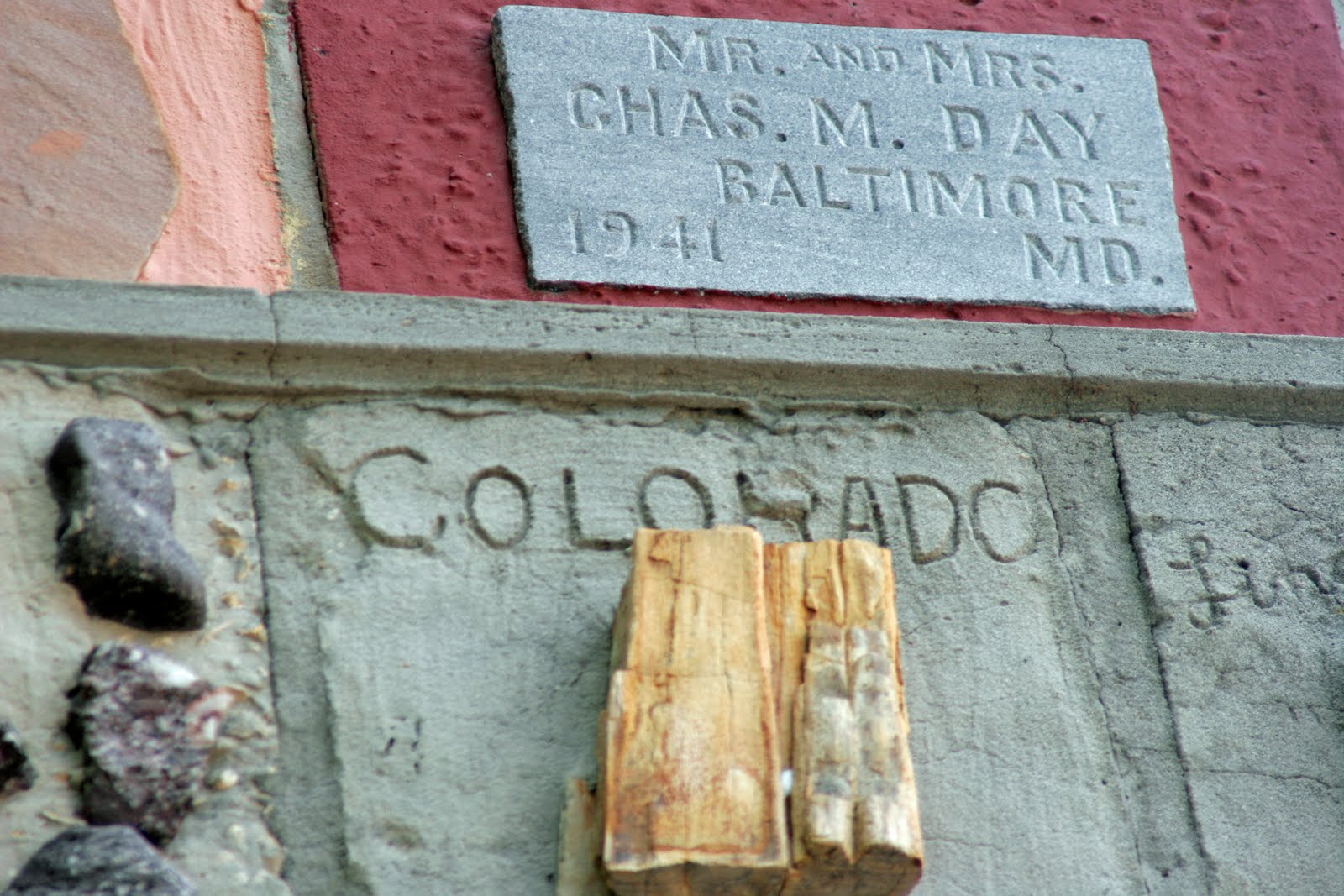
Rocks continued to arrive in Kissimmee for years thereafter, even subsequent to Dr. Bressler-Pettis's death in 1954. Courtesy of the citizens of Kissimmee, many were were added to the monument. Included were slabs with rocks from Alaska and Hawaii, in addition to slabs later sent in by businesses and other nations. As a resident of Maryland and keeper of the Maryland Minerals website, I spent quite a bit of time trying to locate at least one Maryland rock. All I could find was a plaque dated 1941 from Mr. and Mrs. Charles M. Day of Baltimore.

The only other attraction in America I'm aware of that compares in any way to Kissimmee's Monument of States is The Fireplace of States in Bemidji, Minnesota. Its construction took place about eight years before the Monument States after a "resorter" had sent letters to the President of the United States and the governors of each state. I suspect that Dr. Bressler-Pettis inspiration resulted from having passed through Bemidji at some point during those 350,000 miles of driving.

Saturday, April 24, 2010

Maryland Mineralogy Presented at Rochester Symposium

  • Note: Readers are encouraged to check out the Mineral Bliss Podcast about the Rochester Symposium.

Beyond the State or local level, a presentation such as Fred Parker delivered on the morning of April 16 at the Rochester Mineralogical Symposium has long been overdue. As Parker expressed early in his talk, Maryland is "the Rodney Dangerfield of the mineral world." He also credited amateur Maryland geologist Jeff Nagy for much of the presentation's information and perspective. Nagy and Parker have been working together on research intended for an updated printing of Lawrence R. Bernstein's Minerals of the Washington, D.C. Area, which was originally published in 1980 by the Maryland Geological Survey.

The presentation was in three parts as follows:

  • A short history of mining in Maryland

  • Review of a geological map of Maryland

  • A slide show of relevant Maryland Minerals

MINING HISTORY


Despite reports that Captain John Smith recognized the presence of bog iron ore in sedimentary deposits near the Chesapeake Bay, mining did not begin in Maryland until 1740 with patents for iron and copper. Thereafter, Maryland mined iron in substantial quantity, some that was used in the manufacture of munitions during the American Revolution. Pre-revolutionary dumps are still accessible at Mineral Hill in Carroll County. Maryland was also a significant producer of iron for the War of 1812

By the 1840's, Maryland had become one of the world's leading producers of chromium. The ore was mined at Bare Hills and Soldiers Delight in Baltimore County, near Cooptown in Harford County, and near the Pennsylvania State Line in Cecil County. Soon after the Civil War, Maryland was also a source, though never on a major scale, for a variety of other metals including gold, lead, manganese, and zinc. An accompanying slide, possibly the only known photograph of a facility in Maryland where metals were mined, pictured a manganese operation along the Potomac River about five miles upstream from Harpers Ferry. Maryland also produced such nonmetallic materials as mica beryl, feldspar, clay, talc, and coal.

MAP OF PERTINENT GEOLOGY

A map with colors explaining the geology inherent to the state's rock forming minerals was the focus of the presentation's second segment. It emphasized Maryland's central portion, which is more favorable to the pursuit of mineralogy than the coastal plain to the east or Garrett County at the western end of the state. Parker noted the following:

  • Formations of diabase still being quarried along the Susquehanna River near Havre de Grace.
  • Serpentine deposits that appear and reappear in a northeast to southwesterly path from the State Line in Cecil County in the northeast to Montgomery County in the southwest with reappearances in Harford, Baltimore, and Montgomery Counties.
  • Miocene sediment deposits along the Patuxent and also the Potomac Rivers that have yielded an abundance of high quality gypsum crystals.
  • The Baltimore gneiss, a metasediment that occurs sporadically in more spots than could be shown on the map. The Baltimore gneiss hosts many pegmatite intrusions that Parker described as "really quite fascinating in Maryland."
  • The Wakefield Marble accounts for both the active Medford and Portland Quarries in Carroll County as well as the long closed Liberty Mine in Frederick County, once Maryland's biggest producer of copper.
  • Parker noted the existence of Paleozoic sediments between the Wakefield Marble and the Precambrian metavolcanic Catoctin and Braddock mountain ranges. He described the latter as the source of excellent quartz veins near where these mountains approach the Potomac River.
  • Immediately west of the mountains is a region of limestone, shale, and sandstone extending into Pennsylvania and Virginia. It is the source of similar minerals in all three states.

SELECTED MINERAL OCCURRENCES IN MARYLAND

This was the most extensive segment of the presentation. The minerals were shown pursuant to their localities in conjunction with the geological map. Most can be seen on the Picasa slide show at the Maryland Minerals web site. Some, of these minerals also appear in posts on this site from July 18, 2009, May 2, 2009, and April 25, 2009 . Here are some of the highlights noted:

  • Approximately 250 different mineral species have been collected in Maryland.
  • Maryland is the type locality for one mineral, carrollite, which was discovered at the Patapsco Mine in Carroll County, for which it is named.
  • Significant quantities of tourmaline (variety schorl) showing several different habits including terminated crystals up to six inches in chlorite schist have been collected at the Maryland Materials Quarry in the diabase formation along the Susquehanna River.
  • As noted in the geological segment, the Miocene sediment deposits at Chancellors Point in St. Mary's County and Fort Washington in Prince Georges County have produced gypsum crystals of magnificent quality.
  • Garnets up to two inches in chlorite schist are abundant in a wooded area of Baltimore County about 22 miles north of Baltimore City.
  • What Parker belives could be Maryland's most prolific beryl locality is on the banks of a river near the Baltimore/Howard County line at a locality that he and Nagy refer to as the "Waterside Prospect." It is currently covered with water.
  • A particularly interesting slide showed monazite, which is rare in Maryland, from one of several long closed mica mines in Montgomery County.
  • Another slide displayed quartz crystals from a "lost" locality in Clarksville, Howard County, which Parker rediscovered when combing the digs for a housing development that ultimately obliterated the locality.
  • One of the most spectacular slides was of an historic botroydal malachite specimen from Carroll County's Patapsco Mine.
  • Two slides of Maryland gold in quartz, one from Montgomery County, another from Carroll County, attracted major interest.
  • Parker cited the Medford Quarry in Carroll County as Maryland's most prolific locality. He emphasized its abundance of diverse calcite pockets and also noted it as the source of some rare minerals. As an example, a slide of micro lanthanite crystals from a one-time find was shown.
  • The Portland Quarry at Union Bridge in Carroll County, just a few miles from the Medford Quarry, received the distinction of being Maryland's most unpredicable locality Among the slides with which Parker demonstrated this point was one of a transparent yellow wulfenite specimen from a find in the 1970's.
  • Predictably and appropriately, he reserved for the Hunting Hill Quarry in Montgomery County the honor of being Maryland's most mineralogically important locality. Citing the gemmy grossular associated with its serpentine and rodintine, he compared Hunting Hill's geology to Vermont's Eden Mills locality. He then showed slides of some of the seventy one different species that have been collected at Hunting Hill. A slide of xonotlite crystals was particularly noteworthy.
  • An expecially spectacular slide showed quartz crystals that were collected in the soil near Burkittsville in Frederick County prior to the Civil War.
  • Further west in Paleozoic limestone near Hagerstown in Washington County, Parker noted that one of several quarries that are quite similar to one another has produced attractive strontianite as well as native sulphur and celestine.
  • Further west in Washington County, Parker recognized the Pinesburg Quarry for its blue barite crystals and showed a slide of an exceptional specimen from his personal collection.
  • The final and westernmost locality he named was Savage Mountain near Frostburg. Once mined for its fire clay, it was one of Maryland's most popular collecting localities in the 1930's and 1940's. Savage Mountain is best known for geode like nodules filled with crystals of siderite and barite. A highlight was a slide photographed by Yours Truly of such a nodule bearing spectacular needles of millerite up to an inch long.
  • Parker concluded his presentation with an image of that he described as a "doorstop," namely serpentine and chromite with an historic label attached to it. The idea was to make the point that despite the initial impression of numerous mineral people, Maryland's mineralogy amounted to more than than simply these two species.

Note to readers: The next Mineral Bliss post is scheduled to appear at the end of the second week of May, 2010

Sunday, April 18, 2010

Panning for Anatase in Harford County: Part II

Ev parked along the country road paralleling Falling Branch opposite from where a small rivulet flowed into it from the adjacent wooded hillside. We removed from his trunk our waders, rubber gloves with cotton gloves to wear under them, two shovels two buckets, one with 1/4 holes drilled into the bottom third, pans, Ev's "sucker," and baggies. Casing out the stream, Ev pointed out and expressed his preference for spots where the velocity of the water changed, better in front of rocks around which the current swirled with at least some downward motion. He was also eager to pan at the mouth of the small rivulet

As I watched from the bank, Ev waded into the stream, secured his buckets, one placed into another for drainage from top to bottom, and began digging beneath the downstream side of a rock the current was circumventing. For each load, Ev extended his shovel all the way down to scrape the bedrock where gold, as the heaviest substance in the stream, tends to gravitate. Anatase, though nowhere near so heavy as gold, has sufficient specific gravity to do likewise.

After tossing away the larger rocks, Ev turned the linked buckets sideways at an angle to the current to sieve the sand and smaller pebbles to the bottom bucket through the holes in the top one. After repeating the process several times, he transferred the contents of the bottom bucket into the pan.

Since some of the additional sand remaning in the stream beneath the rock ledges was likely to be relatively heavy, Ev scraped the area, seeking out small pockets with a screwdriver before going to work with the "sucker" he is holding in the image at right. He covered the smaller tube with the larger one and placed the tip under the ledge. While holding the smaller tube in place, he pulled on the larger one to suck out water in which additional sand was dispersed. This he poured into the pan.

The next step was the actual panning to reduce the pan's contents to heavy "black sand," much of which would prove to be magnetite. To accomplish this, he held the pan in the stream and swirled its contents back and forth. With assistance from a reasonably mild current, the lighter sediment washed away while small pebbles he removed by hand trended toward the top. A layer of lighter sand settled beneath them. The heavier black sand, meanwhile, gravitated to the bottom of the pan or became caught in the cavities built into its side. This work takes a few minutes and can be tedious. Upon completion, Ev placed the remaining black sand into a marked baggie.

Ev then repeated the entire process where the rivulet entered Falling branch. When finished, he suggested I grab a shovel and try my luck in front of another rock surrounded by swirling current. Albeit with much less finesse, I followed all the previously described steps and eventually produced a small quantity of black sand. We placed it in a marked baggie and headed back to Ev's house, put the sand in his oven to dry, and drove into Jarrettsville for lunch.

When we returned in about 45 minutes, the sand had dried. After removing with a magnet the predominant magnetite, we placed what remained into three film canisters. The fruits of our morning's labors were now ready for observation under Ev's microscope. Checking a few small samples, we found fragments as well as crystals of garnet, minute cubes of goethite after pyrite, specks of pyrite, possibly some beryl, a few black octahedra (Were they chromite? Why didn't I think to retrieve that magnet?), and occasional rough grains of anatase. Ed removed the most interesting material with a special pair of microscopically tipped tweezers. After two hours, we had examined but a small fraction of the sand.

A week has now passed, and Ev just emailed me that he has finished going through the sand from the first two of our three digs. While his second dig at the mouth of the small rivulet hadn't yielded much, his first dig of the day ended up producing "210 little pieces of blue, bark blue, tan (the most), and yellow (the least) anatase," including 3 dark blue double pyramids (all broken),and two sky blue very small flat topped pyramids (complete), and 2 dark blue flat plates.

Meanwhile, I've been out of town over this past week and before leaving had time to check out but a small sprinkling from the film canister bearing the fruits of my own first attempt at panning. A portion of of it is shown at left. Eyes still relatively untrained for spotting anatase, my inclination had been to delay going through the rest until the list of activities on my busy to-do list slowed down a bit. After receiving Ev's recent email, however, a few of the them could have to wait.

Sunday, April 11, 2010

Gold and Anatase in Harford County, Maryland

Rarely does a topic more newsworthy to Mineral Bliss sensibility present itself than the contents of an email received recently from Ev Smith. Included were the above image of anatase crystals he panned from Falling Branch in Harford County Maryland as well as photos of larger specimens of rich chromite and serpentine minerals (right) that he collected near Cooptown. I responded within minutes and soon managed to wrangle an invitation to go panning for anatase with Ev a week later in Harford County's Falling Branch.

Like so many who pan for gold in the Mid-Atlantic, Ev got started with his hobby under the mentorship of Jack Nelson, the late and legendary regional "godfather" of panning. They panned mostly near Great Falls in Montgomery County. This is where Rock Run and other small streams flow through woodlands where gold mining operations were ubiquitous between 1864 and 1940. After Jack's death from cancer in 2002, Ev began panning for gold in streams closer to his home near Jarrettsville in Harford County. He is the only person I know of to actually find gold in Harford County. Most of the flakes in the image at left, Ev panned from Harford County streams. The larger nugget, in the top left corner of the picture, is from a small stream in Pennsylvania just over the Maryland line.

As a protege of Jack Nelson, it didn't surprise me that Ev would look for more than just gold in the material he panned from these streams. Jack was also an avid micromounter and had discovered amidst heavy mineral concentrates from streams in Montgomery County and elsewhere the first cubic garnets ever to be reported and identified. Aware that some of the grains of sand he was extracting were likely to be gem minerals, Ev made a practice of bringing home in baggies the sand that remained at the bottom of his pan at the end of the sifting process. Encountered were rutile, schorl, garnets in hues running a gamut from lavender to deep red, minute cubes of goethite pseudomorph after pyrite, and various other grains of sand not as easy to visually identify. Very likely, they could include, beryl apatite, zircon, and zoisite. The less common anatase was a later find that became apparent after Ev isolated several uncommon anatase grains with their crystal habits intact. More typically the anatase occurs in broken fragments like those in the image at right.

I arrived at Ev's house on Monday, April 5, with a borrowed pair of waders. In short order, we were en route to Falling Branch. Along the way, Ev pointed out to me where he had collected the chromite and serpentine minerals. Minerals of Maryland had described the locality as "serpentine barrens" with numerous chrome prospects in"Coopstown and Vicinity." Assuming this would be a landscape similar to Soldiers Delight or Bare Hills in Baltimore County, I had previously driven through the area looking without success. Instead, what Ev pointed out to me was a lush woodland with a variety of tall trees. For access, permission would need to be obtained at several houses, and Ev was no longer certain which ones. Ev also told me about a copper prospect just a short walk away that was not mentioned in Minerals of Maryland where he once collected some copper bearing minerals.

About ten minutes later, we pulled off a country road along Falling Branch not far from where it empties into Deer Creek. With our waders, a couple of shovels, two large white white buckets, one with 1/4 inch holes drilled through its bottom half, pans, and Ev's "sucker," we headed toward the stream. Next week's Mineral Bliss post will be about our experience.